

Israeli prisons as machines of Palestinian death. Las cárceles israelíes como máquinas de matar palestinos. ENG ESP
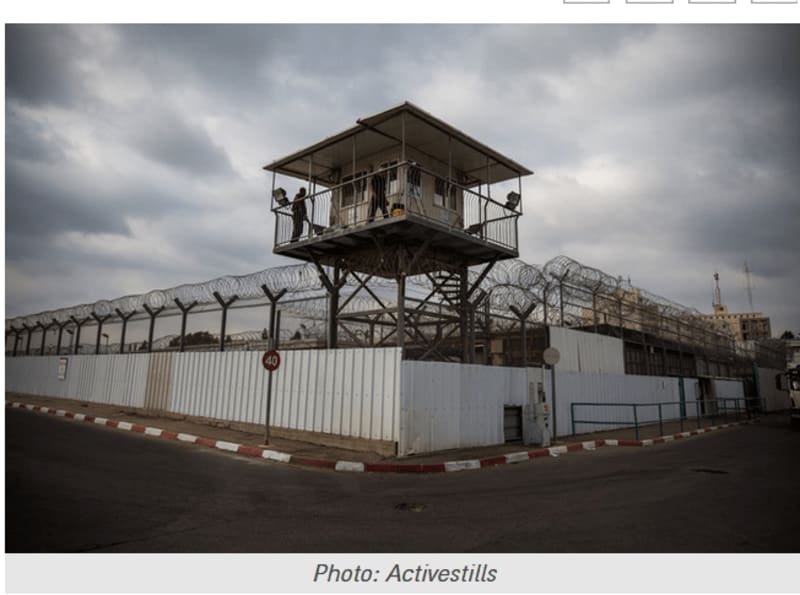
“The logic of the Israeli carceraly system is now one of starvation, beatings, killings” “La lógica del sistema carcelario israelí es ahora de hambrunas, palizas y asesinatos”
ENGLISH
How Israeli prisons went from centers of Palestinian resistance to machines of Palestinian death
Dikla Taylor-Sheinman
Jewish Currents, Fall 2026 issue.
On the first day of 2026, approximately 13 months after Usayd Al-Mahfouth was detained by Israeli forces in an early morning raid on his home in Nablus, I received a frantic phone call from his mother. “Did you hear the news?” she asked, panic rising in her voice. Hassan Issa Al-Qasha’leh, a young Palestinian man arrested around the same time as her son, had just died inside Be’er Sheva prison in southern Israel, six months before his scheduled release. “I am really very worried Usayd is not going to survive,” she told me.
When soldiers came for Usayd, arriving during dawn prayers on December 19th, 2024, he had just turned 17. Once a gregarious teen who loved cooking and riding his horse, Usayd had found his life upended when Israeli soldiers stormed Nablus’s Askar camp that August. He was in the street when soldiers shot him with high-velocity rounds that ignited his clothing and punctured a vein in his left leg, which doctors were forced to amputate the next day. For four days Usayd lay in a coma in the intensive care unit, undergoing multiple skin grafts on his burned hand and lower arm. By the time the soldiers came for him a few months later, his life was no longer in jeopardy, but Usayd was still receiving critical medical treatment. Nevertheless, the soldiers dragged him, hopping on one leg, from the house. He was loaded into a military jeep and taken away.
Neither Usayd’s family nor his lawyer knows what he is accused of, and because he was taken into administrative detention—imprisonment without charge or trial based on an unproven allegation of “dangerousness”—they are unlikely to ever find out. From the handful of prison visits afforded to his lawyer and the testimonies of released detainees, what they do know is this: On the day of his arrest, officers shoved Usayd into the side of a military jeep and beat him so badly that he has suffered from chronic back pain ever since. Then, they took him to Megiddo prison in northern Israel, one of several detention facilities holding Palestinian children designated as “security prisoners”—those accused of “nationalistic” offenses ranging from stone throwing to political violence. Inside, the abuse intensified. Usayd was repeatedly beaten, including on his amputated leg. In the overcrowded cells, he developed asthma and started needing a vaporizer to breathe. He was barely fed and lost a dangerous amount of weight; during visits, his lawyer saw him looking visibly emaciated. “Even someone who enters prison in perfect health suffers a lot,” Usayd’s mother told me, after describing what she had gleaned of Usayd’s plight. “I have nightmares that something happened to him.”
The realities of Israeli prisons are, indeed, increasingly the stuff of nightmares. In March 2025, 17-year-old Walid Khaled Ahmed from the West Bank town of Silwad collapsed while walking in the Megiddo prison yard, hit his head on a railing, and died—the first Palestinian teenager to die in an Israeli prison since the 1967 occupation of the West Bank. Fellow child prisoners pleaded for guards to intervene, but no one came. Only after the children carried Walid’s frail body—he had been suffering from scabies and amoebic dysentery—to the yard’s gate did the prison authorities wheel him away on a gurney.
An Israeli court probe into his death later revealed that Walid was “likely starved.”
The Israeli surgeon who attended the autopsy on behalf of Ahmed’s family, and who is accustomed to operating on late-stage cancer patients and treating extreme anorexia, struggled to reach for a comparison that conveyed the state of the body before him. “The only thing that comes close to that,” he recalled on an episode of This American Life, “in my opinion, is really those pictures of the Holocaust.” (A spokesperson for the Israel Prison Service, when presented with the allegations in this piece, described them as “entirely without factual basis” and claimed that all detainees “are held in accordance of the law, with full regard for their basic rights,” and that the agency “rejects attempts to portray systematic abuse or unlawful conduct by its personnel.”)
More than 100 Palestinian detainees have died in Israeli prisons since October 7th—nearly half the total of the previous 56 years.
The deaths continued: In July 2025, 53-year-old Samir Al-Rifai, from the West Bank village of Rummaneh, died in Israeli custody a week after his arrest. Less than a month later, 21-year-old Ahmad Tazaz’a, from Jenin, went to the prison clinic complaining of weakness and a sore throat; he was pronounced dead shortly afterward. In January came the news of Hasan Al-Qasha’leh’s death. And these were just a small portion of recent fatalities. From 1967 to 2023, an estimated 237 Palestinian prisoners died in Israeli custody. But between October 2023 and June 2026, the number of Palestinian detainees who died in Israeli prisons reached 104—nearly half the total of the previous 56 years. That number does not include hundreds of Palestinians who were taken into custody from Gaza during the first nine months of Israel’s genocidal war and have never been located. “There are something like 300 to 400 Palestinians from Gaza who vanished” during this time, said Naji Abbas, director of the prisoners and detainees department for the NGO Physicians for Human Rights–Israel (PHRI). “These people are probably dead.”
Even those who survive recount dire conditions. In B’Tselem’s 2024 report “Welcome to Hell: The Israeli Prison System as a Network of Torture Camps,” A.H., a Palestinian detainee from Hebron, recalled being beaten, dragged, kicked in the head, and attacked with rifle butts by 14 Israeli prison guards, in addition to facing prolonged starvation. Right before his release, A.H. said, the guard conducting his final interrogation failed to recognize him from the photograph in his file because his facial features had changed drastically after he lost 120 pounds. Speaking to Euro-Med Monitor of his time in Sde Teiman camp, 35-year-old A.S. said that detainees were being held in metal cages where, “from time to time, the dogs would urinate on us”; on other occasions, the army would use the dogs to sexually assault them. Former detainees shared strikingly similar accounts of rape in custody with New York Times writer Nicolas Kristof; among them was a Gazan journalist who recounted being blindfolded and handcuffed before being penetrated by a dog. Revisiting the assault, he told Kristof, was so painful his “heart felt like it might stop.”
These harrowing accounts testify to the ways in which, in recent years, Israeli prisons have become institutions not primarily of incarceration but of torture and death. The use of torture against detainees is, of course, not new; according to legal scholar Neve Gordon, Israeli intelligence officers have long used torture to extract information in initial interrogations. But “today, it’s very different,” Gordon told me. “The torture has metastasized. It has spread to the prison officers that are in charge of taking care of the prisoners in their cells. It is carried out through the prison and all its regulations.” Since taking office in 2022, far-right minister Itamar Ben-Gvir has particularly devoted himself to promoting this metastasis, ensuring that “the conditions of detention” become “part of the punishment for Palestinians,” in the words of PHRI’s Abbas. Before October 7th, this meant a rise in solitary confinement and daily beatings, the reduction of rations, and the denial of lifesaving healthcare. Afterward, these conditions worsened precipitously as Israel mobilized wartime emergency measures to swell its prison population while increasingly shielding itself from scrutiny for what happened behind bars. “The page turned in 2023,” the political theorist Shai Gortler told me. “The logic of the Israeli carceraly system is now one of starvation, beatings, killings.”
For the more than 9,600 Palestinians from the West Bank and Gaza already in Israeli prisons, the roughly 600 others who stand to join them each month if arrest rates hold, and their family members, this shift holds terrifying implications. The reach of the Israeli prison system has long lent it the force of inevitability. During her fieldwork in Bethlehem’s Dheisheh refugee camp in the ’90s, the sociologist Maya Rosenfeld recorded a father of four sons, who had all passed through Israeli jails under administrative detention, telling her: “Just as it was clear to me that every living creature eventually dies, it became evident that every Palestinian man would eventually be taken to prison.” Now, the distance between prison and death seems to be collapsing.
Prisons once held a very different place in the Palestinian imagination. For decades, incarcerated Palestinians—while suffering traumatic conditions—still retained a measure of physical and even political autonomy, and used it to resist Israel’s occupation from the inside.
Such was the case for Jaber Abu Shehadeh, a 56-year-old Palestinian man from East Jerusalem, who asked to be referred to by a pseudonym for fear of being targeted by Israeli police. In 1988, a 17-year-old Abu Shehadeh—already enamored with Yasser Arafat and a member of Fatah—was arrested after he raised a Palestinian flag and threw stones at a passing public bus during a First Intifada protest. A week of near-continuous interrogation and torture inside Jerusalem’s Russian Compound followed. The ordeal involved being hung upside down by his feet, bound in metal rings fixed to the ceiling, whipped, beaten, denied water, and threatened with rape against him and his female family members.
...
[More, here]
ESPAÑOL
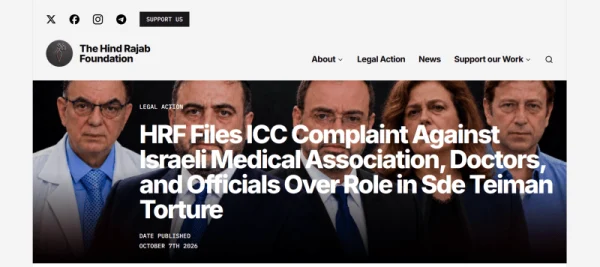
War crimes. The Hind Rajab Foundation to the International Criminal Court: involviment of Israeli Ministry of Health and Ministry of Defense officials, the Israeli Medical Association, medical professionals, and hospital administrators. Crímenes de guerra. La Fundación Hind Rajab ante la Corte Penal Internacional: implicación de funcionarios del Ministerio de Salud y del Ministerio de Defensa de Israel, la Asociación Médica Israelí, profesionales médicos y administradores de hospitales. ENG ESP
Death, torture, and ill-treatment of Palestinian detainees held at the Sde Teiman detention facility since 7 October 2023. Muerte, tortura y malos tratos a detenidos palestinos recluidos en el centro de detención de Sde Teiman desde el 7 de octubre de 2023.
Publicado hoy.
SPAIN. Boycott Teva. October 2026. Update. ESPAÑA. Boicot a Teva. Resumen. Octubre 2026. Actualización. ENG ESP
No one is "innocent," not even Spain. Nadie es "inocente", tampoco España.
Publicado hace 2 días.
Vall d'Hebron Institut de Recerca (VHIR), Barcelona, España, y sus conflictos de interés con Teva. Vall d'Hebron Institute of Research (VHIR), Barcelona, Spain, and its conflicts of interest with Teva. ESP ENG
Dinero (de Teva España) e influencia (de Teva Israel). Money (from Teva Spain) and influence (from Teva Israel).
Publicado hace 8 días.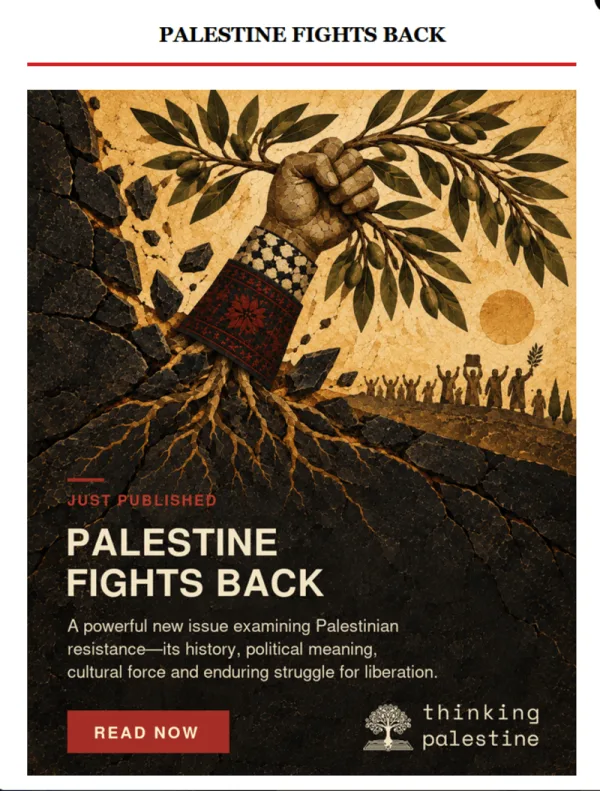
“Resist by all available means—armed resistance, cultural resistance and economic resistance.” «Resistir por todos los medios disponibles: resistencia armada, resistencia cultural y resistencia económica». ENG ESP
Breaking the Taboo: Palestine and Armed Resistance. Sin tabués: la resistencia armada palestina.
Publicado el 17 de septiembre.
Asier y Youssef, miembros de ‘Iranekin Bat’ y Samidoun detenidos y procesados en la Audiencia Nacional.
"Si Youssef y Asier son terroristas, yo también soy terrorista”
Publicado el 11 de septiembre.
1060 días de horror. 2 septiembre 2026. Spanish Revolution
La obscenidad también consiste en eso: convertir una carnicería diaria en ruido de fondo.
Publicado el 7 de septiembre.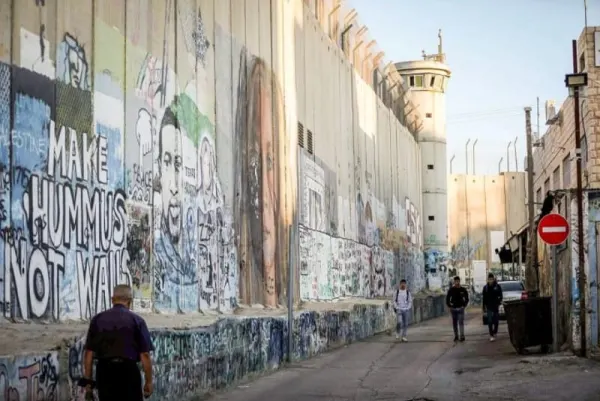
Israel quiere "borrar" a los palestinos de Palestina. Israel wants to "erase" the Palestinians from Palestine. ESP ENG
Israel busca crear un pueblo de muertos vivientes que emigren "voluntariamente". O una matanza brutal. Israel seeks to create a nation of the living dead who emigrate "voluntarily." Or a brutal massacre.
Publicado el 3 de septiembre.
USA support of Israel. The unmatched power of the Israel Lobby. El apoyo de Estados Unidos a Israel. El poder sin parangón del lobby israelí. ENG ESP
Israel has infected the United States through the Israeli lobby and turned it into a zombie that acts in Israel's own best interests. Israel ha infectado Estados Unidos a través del lobby israelí y lo ha convertido en un zombi que actúa en favor del propio Israel
Publicado el 29 de agosto.Ver más / See more
