Alongside calls to stop the immeasurable human suffering in Gaza, global initiatives hope to shine a spotlight on Palestinian literature, identity, and culture.

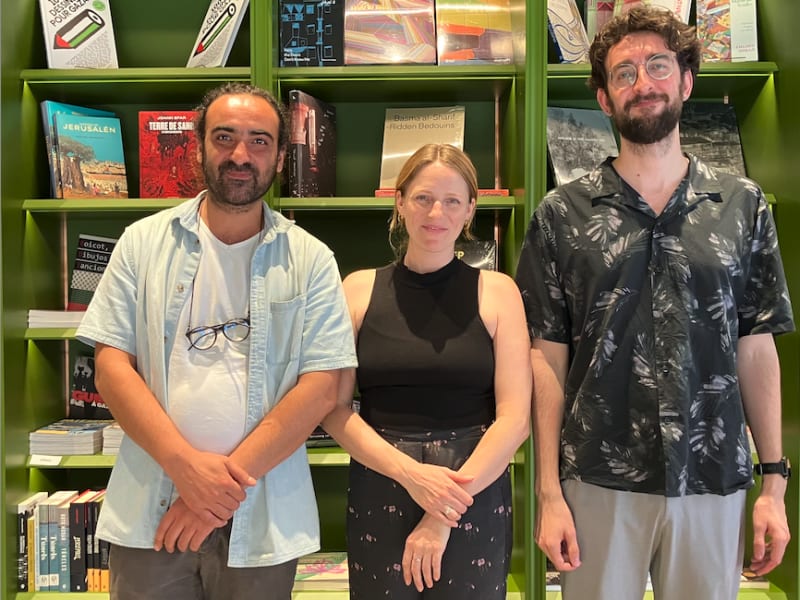
At the recently opened Finestres Palestina bookshop in Barcelona, which carries books focused on Palestinian literature, history, politics and culture (from left): Mohamed Bitari, Olivia Watson, and Xavi Morales (credit: Olivia Snaije).
By Olivia Snaije, Contributing Editor
In 2025, I spoke with the late
András Riedlmayer, who for 35 years served as Director of the Documentation Center of the Aga Khan Program for Islamic Architecture at Harvard University. In 2000, Riedlmayer made international headlines when
he testified before the International Criminal Tribunal for the former Yugoslavia (ICTY) about the deliberate destruction of libraries, archives, and other cultural institutions in Bosnia—the first time that crimes against cultural heritage were tried before an international court. Before his death in February, Riedlmayer had been spending part of his days documenting the destruction of libraries and cultural entities in another region: Gaza.
“I got an idea of how wars and culture intersect,” he told me. “If you want to get rid of a people, then you get rid of their culture.”
Indeed, the destruction of Palestinian cultural heritage has been well documented since 1948. But according to an April 2026 United Nations Report, the widespread destruction in Gaza over the last three years is unprecedented—and alongside calls to stop the ongoing genocide and the immeasurable human suffering, a global effort to save Palestinian literature, identity, and culture has also taken root.
‘Gaza’s Cultural Soul’
 On a recent London Review of Books Podcast, Adam Shatz, U.S. editor of The London Review of Books discussed the ongoing crisis on the ground in Gaza with writer and political analyst Muhammad Shehada and scholar and writer Jehad Abusalim, both from Gaza, but now living abroad. The novelist Safaa Al-Nabaheen, who lives in Gaza, had given Shatz a question for his guests: “Everyone talks about rebuilding homes and hospitals, but what about Gaza’s intellectual soul?” she asked. “With our bookshops, theatres, and universities gone, how do [Shehada and Abusalim] envision the rebuilding of our cultural infrastructure?”
It’s an important question. Since 2024, a growing number of powerful testimonies, reflections, and narratives by Palestinian poets and writers on the ground in Gaza have appeared, in English translation, in magazines and anthologies. For example, Gaza! Gaza! Gaza! in Arablit Quarterly’s collaboration with Gaza’s magazine Majalla 28, and Saqi Books’ Daybreak in Gaza, edited by Mahmoud Muna and Matthew Teller with Juliette Touma and Jayyab Abusafia.
Already in 2023 a group of international publishers, now more than 500, created Publishers for Palestine, which stand for “justice, freedom of expression, and the power of the written word in solidarity with the people of Palestine.”
Over the next year and into 2026 more anthologies and books were published—so many that the 2025 Palestine Book Awards, which cover books written in English, had a record-breaking 80-plus submissions, which represented “more than just numbers,” organizers said, but “a literary movement refusing to be silenced.”
PEN International has built an archive to document the 23 writers and poets who were killed by Israeli forces between October 2023 and September 2024, drawing attention to the ongoing struggle faced by writers in Gaza. PEN International recently featured the Palestinian writer, publisher, and bookseller Mahmoud Muna on a panel called “International Solidarity in a Time of Global Disorder,” where he spoke about cultivating hope for better days to come.
In 2024, Samir Mansour, a bookseller and publisher from Gaza whose bookshops were destroyed by Israeli forces—and rebuilt several times—was awarded the International Publishers Association’s Prix Voltaire, which honors honors “exceptional courage in upholding the freedom to publish.” Today, he still distributes and publishes books, and his son, Mohammed wrote and self-published his father’s biography, Bookseller in Gaza.

Samir Mansour, winner of the 2024 Prix Voltaire Award (Courtesy: IPA).
Circling back to librarians, as Riedlmayer liked to say, “if you really want to make a librarian mad, burn down a library.”
Dominique Dupart (whose work Riedlmayer was following closely) is a French academic and a reader’s representative for the National French Library. In 2025 she co-launched a project called Reading in Gaza in response to “the destruction of books and reading in Gaza.”
Dupart has gathered together a scientific team of 30 volunteers in France, the U.S., and Gaza, who are documenting and mapping the destruction of libraries, universities, cultural centers, bookstores, publishing houses, and printing presses in Gaza. So far, the team has identified roughly 150 destroyed sites—of which 100 were libraries—but there are many more, Dupart says.
The Reading in Gaza team is also building a digital public library for students and families in Gaza, in collaboration with the NGO Academic Solidarity with Palestine, and Gaza History: Inventory of a Bombed Heritage, which tracks destroyed heritage sites.
It should be pointed out that Librarians and Archivists with Palestine have been active since 2013, with the mission to oppose “the closure and destruction of Palestinian libraries and archival institutions; the ongoing attempts to erase, deny or misrepresent Palestinian culture and history; and the embargo of books and other cultural materials from abroad destined for Palestinian libraries, archives, and other cultural institutions.”
‘Memory and Culture’
Two nomadic bookshops run by young Palestinians were also created recently. The U.K.-based Maqam is a nomadic bookshop and a community space for the Arabic speaking world that grew out of Mohammad Masoud’s desire to fill the vacuum left by the London bookshop, Al Saqi, which closed in 2022. Maqam recently held its first European event with a curated selection of books at Casa Palestina, a new Palestinian cultural space in Lisbon, Portugal.

Abed Hawash of DarKoom Mobile Library (credit: Olivia Snaije).
The event was held in collaboration with another nomadic bookshop created by Abed Hawash, who founded DarKoom bookstore in 2024 in Haifa. Hawash is a ’48 Palestinian who grew up within the 1948 borders of Israel. Born in 2002, he played football with an Israeli premier league team until 2023. Always interested in poetry and books, he told Publishing Perspectives that “occupation tries to delete memory and culture” and that the idea of selling books and sharing literature about Palestine carries a meaning that goes beyond the book itself.
Hawash began selling mostly nonfiction books about Palestine in Arabic first at a market and then at a bar in Haifa called Fattoush, selling out each time. Recognizing that there was a need, he decided to try his hand internationally as well. “Gaza was the impulse,” he said. He first began selling his books in Jordan, then moved on to Berlin where a friend from Nazareth was living, then to Sweden, and Spain where he is currently living in Barcelona. Hawash has been learning on the job, selling his books at community fairs and universities, and while he is still dealing with small quantities, shipping remains possible. Hawash also began sourcing books in Arabic for a new branch of the Finestres bookshops in Barcelona.
Finestres Palestina, which carries books uniquely focused on Palestinian literature, history, politics and culture opened last month, designed by a Palestinian architect based in Valencia. At the opening, Finestres owner and president of the Ferrer Foundations, Sergi Ferrer-Salat said, “The question should not be why we are opening a bookstore dedicated to the Palestinian cause, but why no one has done so before.” Finestres Palestina has also started to hold literary events, and in the fall will begin hosting book clubs.
Estefanía Rico, director of the Ferrer Foundations emphasized that the bookshop was created to foster critical awareness and to serve as a space for debate and reflection. “We believe in the infinite transformative power of culture,” she added.
The British social activist and writer Olivia Watson manages the bookshop with the help of bookseller Xavi Morales and the poet, translator and publisher, Mohamad Bitari, who was born in the Palestinian refugee camp of Yarmouk in Syria. The bookshop can stock up to 4,000 books, said Watson, even if there are currently only 2,500, due to shipping problems in the Middle East.
According to Watson, the bestselling titles so far include books by Isabella Hamad, Adania Shibli and Maya Abu Al-Hayat as well as The Queer Arab Glossary edited by Marwan Kaabour. People who come into the bookshop “are very moved to see a commitment and to be in a beautiful place,” said Watson. “The destruction of Gaza has been so complete, and here they see something beautiful as a response.”
‘We Are an Entire World’

Omar Hamad at the Phoenix Library (Credit: The Phoenix Library, Instagram).
Another new initiative that grew out of The Palestine Festival of Literature (Palfest) is an online magazine called The Key.
Run by Sara Yasin, the former managing editor of the Los Angeles Times, the magazine was a reponse to a gap and lack of voices in mainstream spaces, Yasin said, in an interview on the Bulaq podcast. The Key publishes stories that highlight cultural and literary voices, often drawing on writing from the Palfest community, which includes authors such as Molly Crabapple, Viet Thanh Nguyen, or Mazaa Mengiste.
In a recent article for The Key, the poet and writer from Gaza, Husam Maarouf, wrote about the new Phoenix Library in Gaza City.
Omar Hamad lost his personal library and home to Israeli bombings. With a friend, Ibrahim Almasri, they began to retrieve books from the rubble and clean them, collecting and salvaging up to 6,000 books from destroyed libraries. Gathering $110,000 from a crowd funding platform which also tracks their progress, the library opened with works in Arabic and English and includes a wide range of subjects, and a large number of children’s books. Maarouf quotes Hamad, who described the process of collecting the books: “Every time I held a book, I felt immense joy…Every shelf I arranged was part of a larger project: creating a space for books and reminding children and others in Gaza that knowledge should not be abandoned in war.”
As the poet, editor, and curator Mahmoud Al-Shaer wrote from Gaza in 2024, in a series of chronicles that were published as A Year on the Abyss of Genocide: “We are an entire world, with stories to share about our lives.”
About the Author
Olivia Snaije
Olivia Snaije is a journalist and editor based in Paris and Barcelona who writes about translation, literature, the Middle East, and the African continent. She is the author of three books and has contributed to anthologies, newspapers and magazines including The Guardian, New Lines Magazine, and The Africa Report.
*Por Olivia Snaije
Junto con los llamamientos para detener el sufrimiento humano inconmensurable en Gaza, las iniciativas globales esperan poner de relieve la literatura, la identidad y la cultura palestina.
En 2025, hablé con el difunto András Riedlmayer, quien durante 35 años se desempeñó como Director del Centro de Documentación del Programa Aga Khan de Arquitectura Islámica en la Universidad de Harvard. En 2000, Riedlmayer llegó a los titulares internacionales cuando testificó ante el Tribunal Penal Internacional para la antigua Yugoslavia (TICI) sobre la destrucción deliberada de bibliotecas, archivos y otras instituciones culturales en Bosnia, la primera vez que los crímenes contra el patrimonio cultural fueron juzgados ante un tribunal internacional. Antes de su muerte en febrero, Riedlmayer había pasado parte de sus días documentando la destrucción de bibliotecas y entidades culturales en otra región: Gaza.
«Tengo una idea de cómo se cruzan las guerras y la cultura», me dijo. «Si quieres deshacerte de un pueblo, entonces te deshaces de su cultura».
De hecho, la destrucción del patrimonio cultural palestino ha estado bien documentada desde 1948. Pero según un informe de las Naciones Unidas de abril de 2026, la destrucción generalizada en Gaza durante los últimos tres años no tiene precedentes, y junto con los llamamientos para detener el genocidio en curso y el sufrimiento humano inconmensurable, también se ha arraigado un esfuerzo global para salvar la literatura, la identidad y la cultura palestina.
‘El alma cultural de Gaza’
En un reciente podcast de London Review of Books, Adam Shatz, editor estadounidense de The London Review of Books, habló de la crisis en curso sobre el terreno en Gaza con el escritor y analista político Muhammad Shehada y el académico y escritor Jehad Abusalim, ambos de Gaza, pero que ahora viven en el extranjero. El novelista Safaa Al-Nabaheen, que vive en Gaza, le había hecho a Shatz una pregunta a sus invitados: «Todo el mundo habla de reconstruir hogares y hospitales, pero ¿qué pasa con el alma intelectual de Gaza?» Ella preguntó. «Con nuestras librerías, teatros y universidades desaparecidos, ¿cómo prevén [Shehada y Abusalim] la reconstrucción de nuestra infraestructura cultural?»
Es una pregunta importante. Desde 2024, han aparecido un número creciente de poderosos testimonios, reflexiones y narrativas de poetas y escritores palestinos sobre el terreno en Gaza, en traducción al inglés, en revistas y antologías. ¡Por ejemplo, Gaza! ¡Gaza! ¡Gaza!en la colaboración de Arablit Quarterly con la revista de Gaza Majalla 28, y Daybreak in Gaza de Saqi Books, editado por Mahmoud Muna y Matthew Teller con Juliette Touma y Jayyab Abusafia.
Ya en 2023 un grupo de editores internacionales, ahora más de 500, creó Publishers for Palestine, que que defienen «justicia, libertad de expresión y el poder de la palabra escrita en solidaridad con el pueblo de Palestina».
Durante el año siguiente y en 2026 se publicaron más antologías y libros, tantos que los Premios Palestine Book de 2025, que cubren libros escritos en inglés, tuvieron un récord de más de 80 presentaciones, que representaban «más que números justos», dijeron los organizadores, pero «un movimiento literario que se niega a ser silenciado».
PEN International ha construido un archivo para documentar a los 23 escritores y poetas que fueron asesinados por las fuerzas israelíes entre octubre de 2023 y septiembre de 2024, llamando la atención sobre la lucha en curso a la que se enfrentan los escritores en Gaza. PEN International presentó recientemente al escritor, editor y librero palestino Mahmoud Muna en un panel llamado «Solidaridad Internacional en tiempos de desorden global», donde habló sobre el cultivo de la esperanza de que los días mejores están por venir.
En 2024, Samir Mansour, un librero y editor de Gaza cuyas librerías fueron destruidas por las fuerzas israelíes, y reconstruidas varias veces, recibió el Premio Voltaire de la Asociación Internacional de Editores, que honra el «valor excepcional para defender la libertad de publicación». Hoy en día, todavía distribuye y publica libros, y su hijo, Mohammed, escribió y autopublicó la biografía de su padre, Bookseller in Gaza.
Volviendo a los bibliotecarios, como le gustaba decir a Riedlmayer, «si realmente quieres volver loco a un bibliotecario, quema una biblioteca».
Dominique Dupart (cuyo trabajo Riedlmayer estaba siguiendo de cerca) es un académico francés y representante del lector de la Biblioteca Nacional Francesa. En 2025 co-lanzó un proyecto llamado Reading in Gaza en respuesta a «la destrucción de libros y lectura en Gaza».
Dupart ha reunido a un equipo científico de 30 voluntarios en Francia, Estados Unidos y Gaza, que están documentando y mapeando la destrucción de bibliotecas, universidades, centros culturales, librerías, editoriales y imprentas en Gaza. Hasta ahora, el equipo ha identificado aproximadamente 150 sitios destruidos, de los cuales 100 eran bibliotecas, pero hay muchos más, dice Dupart.
El equipo de Reading in Gaza también está construyendo una biblioteca pública digital para estudiantes y familias en Gaza, en colaboración con la ONG Solidaridad Académica con Palestina y Gaza Historia: Inventario de un Patrimonio Bombardeado, que rastrea sitios patrimoniales destruidos.
Cabe señalar que los bibliotecarios y archiveros con Palestina han estado activos desde 2013, con la misión de oponerse «al cierre y destrucción de bibliotecas palestinas e instituciones de archivo; los intentos en curso de borrar, negar o tergiversar la cultura y la historia palestina; y el embargo de libros y otros materiales culturales del extranjero destinados a bibliotecas, archivos y otras instituciones culturales palestinas».
‘Memoria y cultura’
Recientemente también se crearon dos librerías nómadas dirigidas por jóvenes palestinos. Maqam, con sede en el Reino Unido, es una librería nómada y un espacio comunitario para el mundo de habla árabe que surgió del deseo de Mohammad Masoud de llenar el vacío dejado por la librería londinense, Al Saqi, que cerró en 2022. Maqam celebró recientemente su primer evento europeo con una selección curada de libros en Casa Palestina, un nuevo espacio cultural palestino en Lisboa, Portugal.
El evento se celebró en colaboración con otra librería nómada creada por Abed Hawash, quien fundó la librería DarKoom en 2024 en Haifa. Hawash es un palestino del 48 que creció dentro de las fronteras de Israel en 1948. Nacido en 2002, jugó fútbol con un equipo de la Premier League israelí hasta 2023. Siempre interesado en la poesía y los libros, le dijo a Publishing Perspectives que «la ocupación intenta borrar la memoria y la cultura» y que la idea de vender libros y compartir literatura sobre Palestina tiene un significado que va más allá del libro en sí.
«La ocupación intenta borrar la memoria y la cultura».
Hawash comenzó a vender en su mayoría libros de no ficción sobre Palestina en árabe, primero en un mercado y luego en un bar en Haifa llamado Fattoush, agotándose cada vez. Reconociendo que había una necesidad, decidió probar también suerte a nivel internacional. «Gaza fue el impulso», dijo. Primero comenzó a vender sus libros en Jordania, luego se mudó a Berlín, donde vivía un amigo de Nazaret, luego a Suecia y España, donde actualmente vive en Barcelona. Hawash ha estado aprendiendo en el trabajo, vendiendo sus libros en ferias comunitarias y universidades, y aunque todavía está lidiando con pequeñas cantidades, el envío sigue siendo posible. Hawash también comenzó a adquirir libros en árabe para una nueva sucursal de las librerías Finestres en Barcelona.
Finestres Palestina, que lleva libros centrados exclusivamente en la literatura, la historia, la política y la cultura palestinas, se inauguró el mes pasado, diseñados por un arquitecto palestino con sede en Valencia. En la inauguración, el propietario de Finestres y presidente de las Fundaciones Ferrer, Sergi Ferrer-Salat, dijo: «La pregunta no debería ser por qué estamos abriendo una librería dedicada a la causa palestina, sino por qué nadie lo ha hecho antes». Finestres Palestina también ha comenzado a organizar eventos literarios, y en otoño comenzará a organizar clubes de lectura.
Estefanía Rico, directora de las Fundaciones Ferrer, enfatizó que la librería fue creada para fomentar la conciencia crítica y servir como espacio para el debate y la reflexión. «Creemos en el infinito poder transformador de la cultura», agregó.
La activista social y escritora británica Olivia Watson dirige la librería con la ayuda del librero Xavi Morales y del poeta, traductor y editor, Mohamad Bitari, que nació en el campo de refugiados palestinos de Yarmouk en Siria. La librería puede almacenar hasta 4.000 libros, dijo Watson, incluso si actualmente solo hay 2.500, debido a problemas de envío en el Medio Oriente.
Según Watson, los títulos más vendidos hasta ahora incluyen libros de Isabella Hamad, Adania Shibli y Maya Abu Al-Hayat, así como The Queer Arab Glossary editado por Marwan Kaabour. Las personas que vienen a la librería «se conmueven mucho al ver un compromiso y a estar en un lugar hermoso», dijo Watson. «La destrucción de Gaza ha sido tan completa, y aquí ven algo hermoso como respuesta».
«Somos un mundo entero»
Otra nueva iniciativa que surgió del Festival de Literatura de Palestina (Palfest) es una revista en línea llamada The Key.
Dirigida por Sara Yasin, la ex editora gerente del Los Angeles Times, la revista fue una respuesta a una brecha y falta de voces en los espacios convencionales, dijo Yasin, en una entrevista en el podcast Bulaq. The Key publica historias que destacan voces culturales y literarias, a menudo basándose en escritos de la comunidad Palfest, que incluye autores como Molly Crabapple, Viet Thanh Nguyen o Mazaa Mengiste.
En un artículo reciente para The Key, el poeta y escritor de Gaza, Husam Maarouf, escribió sobre la nueva Biblioteca Phoenix en la ciudad de Gaza.
Omar Hamad perdió su biblioteca personal y su hogar a causa de los atentados israelíes. Con un amigo, Ibrahim Almasri, comenzaron a recuperar libros de los escombros y limpiarlos, recogiendo y rescatando hasta 6.000 libros de bibliotecas destruidas. Reuniendo 110.000 dólares de una plataforma de financiación colectiva que también realiza un seguimiento de su progreso, la biblioteca se inauguró con obras en árabe e inglés e incluye una amplia gama de temas y un gran número de libros infantiles. Maarouf cita a Hamad, quien describió el proceso de recolección de los libros: «Cada vez que sostenía un libro, sentía una inmensa alegría… Cada estante que arreglaba era parte de un proyecto más grande: crear un espacio para los libros y recordar a los niños y a otros en Gaza que el conocimiento no debe abandonarse en la guerra».
Como escribió el poeta, editor y curador Mahmoud Al-Shaer desde Gaza en 2024, en una serie de crónicas que se publicaron como Un año en el abismo del genocidio: «Somos un mundo entero, con historias para compartir sobre nuestras vidas».
*Olivia Snaije es una periodista y editora con sede en París y Barcelona que escribe sobre traducción, literatura, Oriente Medio y el continente africano. Es autora de tres libros y ha contribuido a antologías, periódicos y revistas, incluyendo The Guardian, New Lines Magazine y The Africa Report.