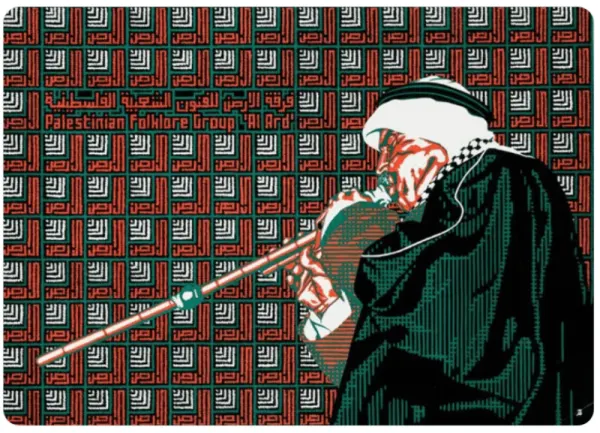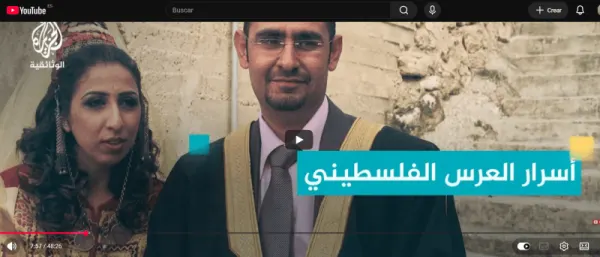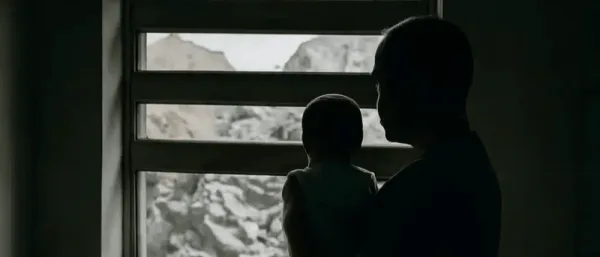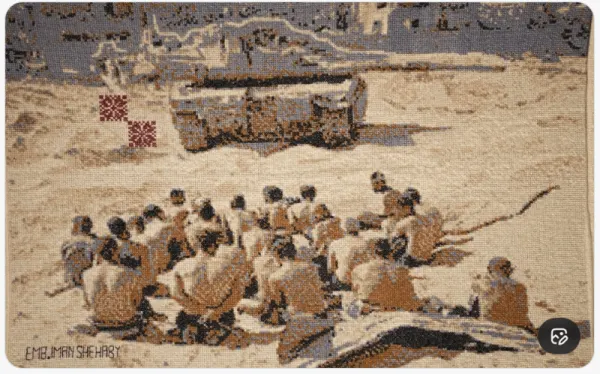

Whether perpetuating traditional artistic forms such as embroidery, or embracing the most contemporary innovations, installations or videos, without neglecting of course painting, which remains the dominant means of expression, sculpture or graffiti, Palestinian artists as a whole express their people’s desire for life and beauty, and their refusal of confinement, despite the hardships and humiliation experienced on a daily basis.
Alongside filmmakers, photographers, musicians, dancers, and even young rooftop acrobats who “fly over the nest of checkpoints” that their country has become, Palestinian visual artists, both from within the country and from the diaspora, reaffirm the presence of their creations at the heart of universal art.

“The refugee camp” by Alaa Albaba

“In a country where the blood of the rose is a martyr and the blood of the martyr is a rose” by Rehaf Al Batniji

Khaled Husseyin, “I Miss You So Much”, Deir al-Balah, Gaza (2024).

Mustafa Mohanna, “Hope on the Road”, northern Gaza (2024).

Ayman Baalbaki, Al Moulatham, 2012, acrylic and painted fabric on canvas.


Juhaina Habibi Kandalaft, Jaffa, 2015, oil on canvas, 200 cm x 200 cm.
“Mother and child” by Sliman Mansour, 2009

Sliman Mansour‘s painting “Jamal Al Mahamel”, 2005, is considered the most famous work of art by a Middle Eastern artist. It depicts a man carrying on his back the burden of his nostalgia, as well as the weight of the entire Palestinian cause.
This is the work of artist Sliman Mansour, one of the doyens of Palestinian art. Having had his works confiscated time and again, he continues to periodically brave Israeli checkpoints on his way from Jerusalem, where he lives, to his studio in Ramallah. Mansour’s work is an ambassador for memory. He stages the weight of memory through powerful canvases, such as Jamal el Mahamel, considered the most famous painting by a Middle Eastern artist, and sold at Christie’s Dubai in 2015. A work representing a man in exile crumbling under the weight of memory; a memory in the shape of an eye, as if forcing us to see the invisible: nostalgia as perpetual baggage. It’s also the weight of the emotional burden,” he confides. I’m not a refugee, but when I go to Jaffa, Acre, Haifa or Galilee, I feel the loss and consequences of the Nakba – the 1948 forced exodus suffered by the Palestinians – a feeling that materializes all the more when I observe the way they are treated, as foreigners or second-class citizens.” A chronic exile at home.

The Palestinian woman, symbol of life and strength, “The immigrant” by Sliman Mansour 2017
The Palestinian woman, wearing the embroidered tunics typical of the mothers of his childhood, also appears as a central figure in many of his works. A creative symbol of strength and life, she is reminiscent of the famous photograph of Frida Kahlo taken by Nickolas Muray in 1946 on her New York rooftop, where the open claim of an outfit so out of context becomes a revolutionary anthem. But for Mansour, the woman is above all a symbol of collective identity and its perpetuation.
In other of his canvases, certain key symbols of Palestine recur, such as the olive tree and citrus fruits, but also the golden dome and that joyous tangle of buildings, an oasis of carefree living, a mirage of peace where earth and mother become the same refuge, and whose memory seems so distant that one wonders if it ever really existed.

“Solitude” by Leila Shawa, 1988
Leila Shawa, a Gazan artist who died in October 2022, is still regarded as the mother of Arab revolutionary art, for all her naive landscapes, a poignant reminder of the heat of another time. Through her canvases, she let the world see Palestine as it would never be seen again. A way of denouncing the occupation, by freezing in time a landscape while it still made sense, while it was not yet dislocated. A landscape with a very particular poetry, its electric wires, footbridges and staircases reminding us of the close ties of neighborliness and, more generally, interdependence between its inhabitants.
Sliman Mansour, too, nourishes in many of his works the memory of a golden age when Jerusalem and its labyrinthine houses slept in immaculate serenity. However, he tells us that in his latest canvases, painted during the recent events in Gaza, his landscapes are becoming duller, to the point of becoming almost monochromatic.

Maher Naji, “Dabbka”
For his part, Gazan painter Maher Naji has long drawn inspiration from his childhood memories before leaving Palestine to study in St. Petersburg, and above all, from his mother’s stories.
This is how his paintings become evanescent silhouettes, singing the times of a full history and vivid legends.
His canvases on display at the Palestine Museum in Woodbridge take on just this gentleness, under the motto of “letting art and love be our common language”.
Maher Naji confides: “When I was still living in Russia, I was influenced by European Romanticism, and painted more the embodiment of traditions, such as scenes of peasants in the fields and women dancing at weddings, because I am also convinced that the cultural and civilizational history of any people is a pillar for the continuity of its development.
But when I returned to live in Gaza, my work began to be more closely linked to the reality in which I lived”.
Naturally, the artist is the child of his environment. Naji returned to live in Gaza in 1994, nurturing a sense of double exile that seems to intensify in his work with each new canvas. This can be seen in his series, in which Palestinian and Russian landscapes merge and become one, as if to mend the fundamental rift through the imaginary.
Maher Naji explains: “As Palestinians, we carry within us nostalgia, but also survival and renewal. Thus, attachment to one place replaces the other, and nostalgia becomes mutual.”
In recent years, some of his works have taken an unprecedented turn: that of revolution, of anger. “Of course, some of my canvases express resistance to oppression head-on, but I prefer to approach the conflict between my people and the occupier through works with historical or mythological content, and seek a more structural understanding of the conflict”

Khaled Hourani, “This Is Not a Watermelon”, acrylic on canvas, 90x90cm diameter (2021).
Khaled Hourani (b. 1965, Hebron, West Bank, Palestine) is an influential conceptual artist, curator and writer.
He was artistic director and general manager of the International Academy of Art Palestine.
He was also Director General of the Fine Arts Department of the Palestinian Ministry of Culture.
He was awarded the 2013 Leonore Annenberg Prize for Art and Social Change – Creative Time, New York.
In 2014, he organized his first retrospective at the CCA, Glasgow, and Gallery One, Ramallah.
He also organized a second retrospective at Darat al-Funun, Amman, Jordan, in 2017.
Mr. Hourani is behind the Stone Distance to Jerusalem project and the 2011 exhibition “Picasso in Palestine”, a two-year collaboration between the Palestine International Academy of Art and the Van Abbemuseum in Eindhoven, Netherlands.
Pablo Picasso’s “Buste de Femme” (1943) was, against all odds, brought to Ramallah and exhibited to a Palestinian public, under armed guard. Hourani has participated in numerous group shows and curated exhibitions in Palestine and abroad.
His humorous work “This Is Not a Watermelon” uses the very colors that the Israelis have forbidden Palestinian artists to use in their works.

Banksy’s “Flying Balloon Girl” graffiti has adorned the separation wall between Israel and the occupied West Bank since 2005.
Several international artists have had the courage to denounce the occupation in the course of their careers, and to do their bit for peace.
Banksy’s stencil murals on the separation wall are now world-famous, including his Flying Balloon Girl graffiti, which is reminiscent of his other work Girl With Balloon, a reproduction of which was spectacularly self-destructed at its auction in London, in October 2018 by Sotheby’s.
A reminder that his message of freedom, his homage to childhood innocence and his appeal to hope are not for sale, and that he does not condone seeing his art extracted from its situational context and reduced to the status of a product.

Rebecca Odes, “War is not healthy for children”, 2023 .
New York watercolorist Rebecca Odes has also paid homage to broken childhood, with two series of portraits of child victims of massacres and hostage-taking, both by Hamas and Israel, inspired by the famous quote by American Jewish pacifist activist Lorraine Schneider: “War is not healthy for children and all living beings”.
A way of showing that empathy and the right to justice are not reserved for one ethnic group more than another.
Some rare Israeli painters also take the timid risk of taking a stand for peace.
But for the time being, the Israeli artists most deeply committed to a free Palestine are the filmmakers and authors.
The artistic descendant of a line of committed Israeli filmmakers such as Eyal Sivan, who paved the way with films like “Jaffa, the Orange Mechanic” and “Izkor, the Slaves of Memory”, Israeli filmmaker Yuval Abraham bravely denounced the apartheid that prevails against Palestinians when he received his Berlinale prize on February 24 for his documentary “No Other Land”.
His speech earned him an avalanche of death threats.
Yet it’s by sharpening their freedom of thought that Israeli artists will set an example, proving that origins don’t have to make us pawns, and that humanism and critical thinking weigh far more in the balance of our futures than blind patriotism.

Jonathan Glazer after winning the Oscar for Best International Film (Jeff Kravitz).
Israeli director Avi Mograbi also defended a powerful documentary at the recent International Film Festival and Forum on Human Rights (FIFDH) in Geneva, denouncing his government’s colonialist practices.
In the same week, Jewish-born London director Jonathan Glazer called for greater awareness of the scourge of occupation when he received his Oscar for his film “The Zone of Interest”, dealing with the sensitive subject of the Holocaust, declaring that his film was precisely intended to show where dehumanization leads.
As for literature, from Ilan Pappé to Shlomo Sand, via Avi Schlaïm, these Israeli authors and historians have dedicated their lives to denouncing, in a referential way and at their own expense, truths they could not keep quiet about.
They mingle their voices with those of Palestinian authors such as Refaat Alareer, killed last December in an Israeli army raid, and whose last poem to the world before his death has a poignant message: “I am you”.

Majd Masri, “Hidden 2”, acrylic on paper, 32x24cm (2022).
Majd Masri (b. 1991, Jerusalem) is an abstract artist, who took part in the 2016 Palestinian Young Artist of the Year competition at London’s Mosaic Rooms.
In an email, she writes that “she loves the sea and the idea of us Palestinians in the West Bank not being able to be close to the sea.
We are always surrounded by checkpoints and have to get permission to go to the other side of our towns.
I’m one of millions of people looking for ways to escape this reality and another way to express these feelings of lost, limited chances.”
In “Hidden 2”, she reflects “the sounds and waves of the sea in color in paint, and finds in the blue sky a reflection of the compensation she seeks.
In abstract works without objects or figures, mass and emptiness leave space for the viewer to ask questions and possibly find solutions.”
A drawing from her “Haphazard Synchronizations” series (2017) graced the cover of my novel, Mother of All Pigs.
Masri won second place in the 2018 Ismael Shamout Prize for Visual Arts at Dar al-Kalima University’s College of Arts and Culture in Bethlehem.

Yazan Abu Salameh, “View from My Studio”, ink and acrylic on paper, 48x35cm (2022).
Born in Jerusalem in 1993, Yazan Abu Salameh has taught art in several community centers, including the Aidya refugee camp in Bethlehem.
He studied fine arts at Dar al-Kalima University and has taken part in group exhibitions in Palestine, Jordan and the United Arab Emirates.
He won third prize in the “Let’s Make It Glow” exhibition, organized in 2019 by the municipality of Turin, Italy.
He exhibited at the Ramallah Art Fair, in 2021 and 2020. Art Dubai recently characterized his art as an exploration of “urban geographies … depicting what can be seen as miniature maps that reflect the remnants of childhood memories, concrete blockades and watchtowers, as well as Palestinian neighborhoods from a bird’s-eye view.”
In 2021, Salameh’s solo exhibition took place at Zawyeh Gallery, Dubai. He lives and works in Bethlehem.

Nabil Anani, “Sabastiya”, acrylic and mixed media on canvas, 100x91cm (2022).
Nabil Anani (born 1943 in Latrun, West Bank, Palestine) is a leading artist and influential supporter of the contemporary Palestinian art movement.
Born under the British Mandate, he experienced the Nakba firsthand. He witnessed the 1967 Six-Day War from Egypt and came of age as an artist in Palestine during the first and second Intifadas.
With Vera Tamari and Tayseer Barakat, he founded the New Vision Movement, a precursor to the BDS movement, which boycotted Israeli products and used natural materials—leather, henna, and plant dyes—in art.
His works have been widely exhibited in the Middle East, Europe, North America, and Japan. He is the winner of the King Abdullah II Arab World Prize for Fine Arts in 2006.


Rana Samara, “Landscape Dream 1”, acrylic and spray paint on canvas, 53x58cm (2022).
Rana Samara (born 1985 in Jerusalem) is an artist who graduated from the Palestine International Academy of Art, Ramallah, in 2015.
A year later, for her first solo exhibition, “Intimate Space,” at Zawyeh Gallery, Ramallah, she interviewed women from the al-Amari refugee camp about virginity, sexual desire, relationships, and roles.
Her second solo exhibition, “Inner Sanctuary,” took place in 2022 at Zawyeh Dubai.
Samara has participated in several local and international group exhibitions and art fairs, including Contemporary Istanbul, Turkey (2019); Art Dubai, UAE (2017 and 2019); Beirut Art Fair (2017); and Ramallah Art Fair (2020).
Known for her vibrant paintings of interior spaces, from living rooms to bedrooms, Samara explores intimacy in nature in her “Landscape Dream” series.

Bashar Alhroub, “Myth 1”, ink and charcoal on paper, 39x29cm (2017).
Bashar Alhroub (born 1978 in Jerusalem) works in a variety of media, including drawings, paintings, photographs, and video installations.
According to his website: His art addresses “the controversy of place, questioning its role in humanity and its influence on creativity… His work is deeply influenced by sociopolitical sentiments that affirm the artist’s identity as well as his desire to belong to a social and cultural community rooted in a particular place. Alhroub constantly strives for a sense of attachment, a sense of meaningful ownership of that place.”
His work is included in several international collections and museums.
In 2001, he received a Bachelor of Fine Arts degree from Al-Najah University in Nablus. He was awarded a Ford Foundation Fellowship to pursue his Master of Fine Arts, which he completed after graduating from the Winchester School of Art at the University of Southampton, UK, in 2010.
His works have been exhibited by Mosaic Rooms, and he has been an artist-in-residence at the Delfina Foundation in London.
In 2012, he received first prize at the 14th Bangladesh Asian Art Biennale.

Dina Mattar, “Untitled 1”, acrylic on canvas, 32x27cm (2019).
Dina Mattar (born 1985 in Gaza) is a painter from al-Bureij, a densely populated refugee camp where judicial assassinations and incursions by tanks and helicopter gunships, attacks, and assaults by the IDF have taken place.
Mattar’s paintings are fable-like and bold. “My use of vibrant colors is an invitation to hope, optimism, and joy. They are an indication that we still exist… My work manifests my insistence and perseverance to exist, and to love life through all that is beautiful.”
Mattar received her BA in Art Education from Al-Aqsa University in Gaza City in 2007 and has participated in exhibitions and workshops in Gaza in cooperation with the A.M. Qattan Foundation and the French Cultural Center.
She has exhibited in Lebanon, Geneva, and France.

Tayseer Barakat, “Summer’s Rain”, acrylic on canvas, 60x75cm (2020).
Tayseer Barakat (born 1959, Jabaliya Refugee Camp, Gaza) is an influential Palestinian artist whose life and art have been shaped by war, conflict, and displacement.
His family was originally from al-Majdal, a village in the Lower Galilee that was razed by Zionist forces in 1948.
He spent his formative years in Jabaliya Refugee Camp, Gaza.
He earned a BA in painting from the Cairo College of Fine Arts at Helwan University, and in 1983, he returned to Palestine and taught art at the UNRWA Women’s Teacher Training Center in Ramallah. In 1981, he walked for forty days across the West Bank, strengthening his ties with the towns and villages obliterated by the occupation.
Barakat’s work “is based on extensive research into the ancient arts of the region as a whole, drawing inspiration from Canaanite, Phoenician, Mesopotamian, and ancient Egyptian cultures. However, he does not strictly adhere to a particular style. Rather, his practice relies on intuition, imagination, and the dynamics of the work itself as it takes shape.”
A member of the New Vision movement, he pioneered the use of local media and crafts in fine art.
Barakat is a founding member of the al-Wasiti Art Center in East Jerusalem and al-Hallaj Hall in Ramallah, the Palestine International Academy of Art, and the Palestinian Contemporary Art Association (PACA).
His international exhibitions include the 6th Sharjah Biennial (2003), the Arab World Institute, Paris (1997), the São Paulo Biennial (1996), and the Museum of Modern Art (1993).
He lives and works in Ramallah.

Khaled Hourani, “This Is Not a Watermelon”, acrylic on canvas, 90x90cm diameter (2021).
Khaled Hourani (born 1965 in Hebron, West Bank, Palestine) is an influential conceptual artist, curator, and writer.
He was the Artistic Director and Director General of the International Academy of Art Palestine.
He was also the Director General of the Fine Arts Department at the Palestinian Ministry of Culture.
He received the 2013 Leonore Annenberg Award for Art and Social Change – Creative Time, New York.
In 2014, he organized his first retrospective at the CCA, Glasgow, and Gallery One, Ramallah. He also organized a second retrospective at Darat al-Funun, Amman, Jordan, in 2017.
Mr. Hourani is the driving force behind the Stone Distance to Jerusalem project and the 2011 exhibition “Picasso in Palestine,” a two-year collaboration between the International Academy of Art in Palestine and the Van Abbemuseum in Eindhoven, the Netherlands.
Pablo Picasso’s “Buste de Femme” (1943) was unexpectedly brought to Ramallah and exhibited to a Palestinian audience under armed guard. Hourani has participated in numerous group exhibitions and curated exhibitions in Palestine and abroad.
His humorous work “This Is Not a Watermelon” uses the very colors that the Israelis have banned Palestinian artists from using in their works.

Malak Mattar is 23 years old. She was born and raised in Gaza.
She began painting at the age of 13, when she was locked in her home for 51 days due to Israeli gunfire during the Gaza War.
Painting has become for Malak Mattar “a sanctuary” to recount “the injustices” suffered in her “open-air prison.”
Her expressive and resilient paintings depict women in struggle demanding freedom for all.

At 86, Samia Halaby is considered a pioneer of abstract painting.
She fled Palestine for Lebanon and then the United States with her family after the Nakba in 1948.
For her, painting is intrinsically linked to the societies in which we live and allows us to make new aesthetic discoveries.

Banksy, “Boy playing with a jetfighter kite” (street art)
“If it is written that I must die…”
Refaat Alareer was a poet, writer, and university professor of literature in Gaza. An activist, he also co-founded the organization We Are Not Numbers, which connects experienced writers with young writers in Gaza. He wrote this poem in English on November 1, 2023. This Gazan intellectual was killed on the night of December 6-7, 2023, along with seven other members of his family, in an Israeli raid that targeted his home.
“If it is written that I must die
Then it will be up to you to live
To tell my story
To sell these things that belong to me
And buy a canvas and string
Make it very white
With a long train
So that a child somewhere in Gaza
Staring into the eyes of paradise
Waiting for his father
Gone suddenly
Without having said goodbye
To anyone
Not even to his flesh
Not even to his soul
So that a child somewhere in Gaza
May see this kite
My own kite
That you will have fashioned
Which will fly up there
High up
And that the child may for a moment think
That this is an angel
Returned to bring him love
If it were written that I must die
Then may my death bring hope
May my death become a story.”


The sculptures of Palestinian artist Rana al-Ramlawi represent the suffering of Palestinians.
It is in Gaza that the artist crafts her impressive, powerfully evocative humanist work.

This photo by Mohammed Salem, taken on October 17, 2023, at Nasser Hospital in Khan Younis, in the southern Gaza Strip, won first prize in the 2024 World Press Photo Awards. © Mohammed Salem.
The poignant image of a grieving Palestinian woman holding her young niece, killed in an Israeli strike in the Gaza Strip, won first prize in the World Press Photo Awards on Thursday, April 18, 2024.

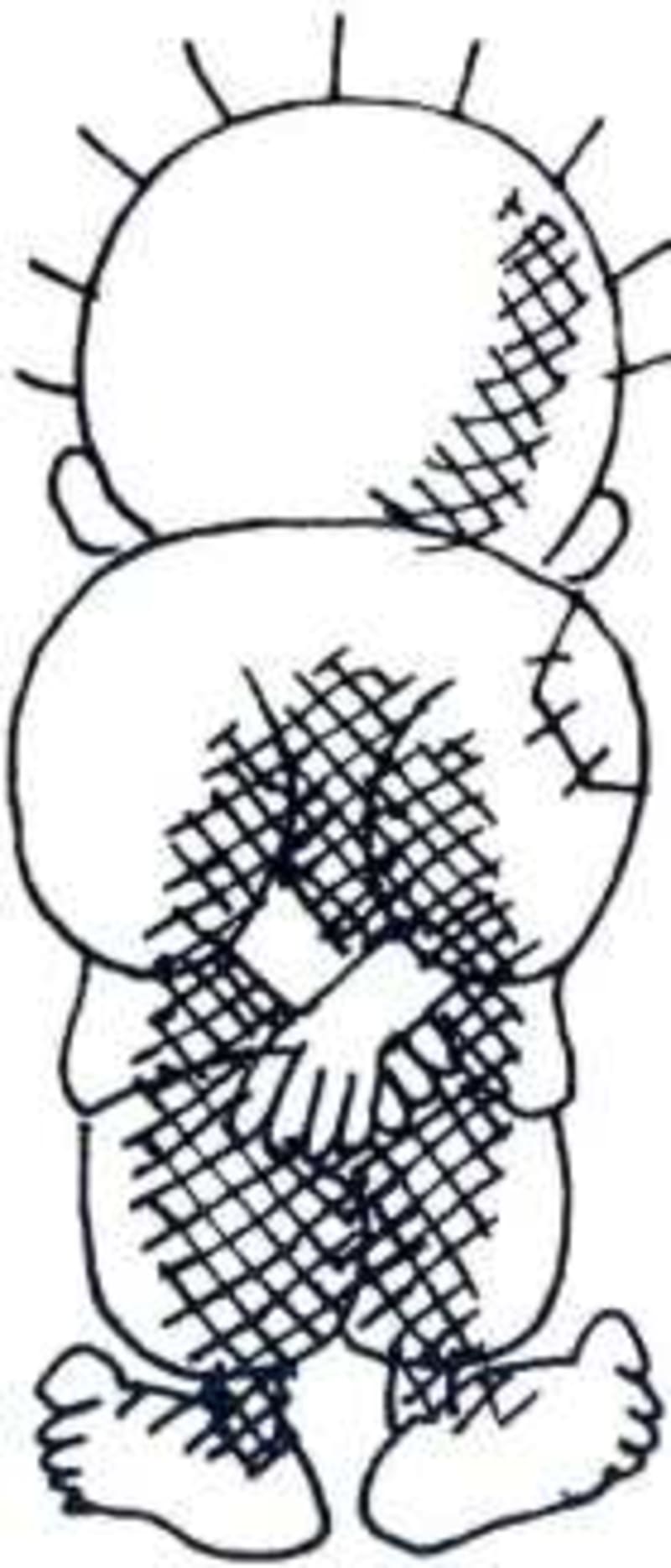
“Handala,” a character created in 1969 by cartoonist Naji Al-Ali (1937-1987).
The character of Handala is emblematic of Palestinian identity. Dressed in rags, always seen from behind, with clasped hands, he symbolizes the tenacity of a people waiting for a state. When it comes into being, Handala will show his face.

Education is a form of resistance. Schoolgirls in Rafah, southern Gaza Strip ©Véronique Vercheval

Film, comedy-drama by Eran Riklis, 2008.
Salma lives in a small Palestinian village in the West Bank, located on the Green Line that separates Israel from the occupied territories. Her lemon grove is considered a security threat to her new neighbor, the Israeli Minister of Defense. He orders Salma to raze the trees under the pretext that terrorists could be hiding there. Salma is determined to save her magnificent lemon trees at all costs, even if it means going before the Supreme Court to face the formidable army lawyers supported by the government.
But a Palestinian widow is not free to act freely, especially when a simple neighborhood matter becomes a major strategic issue. Salma finds an unexpected ally in Mira, the minister’s wife.
A bond develops between the two women that goes far beyond the Israeli-Palestinian conflict.

This autobiographical account retraces the author’s years as a student in the United States.
It is first and foremost an initiatory journey, during which the author draws us into his inner landscapes: the loss of the obvious, the perpetual quest for meaning, and above all, the questioning of madness, the book’s central theme.
A keen connoisseur of Arab and world literary heritage, Hussein al-Barghouti delicately captures, alternating between description, introspection, and meditation, the constant tension between these two constituent parts of himself: the Palestinian popular imagination and urban modernity, the theater of all experimentation.
“Probably the finest achievement of Palestinian prose literature,” writes Mahmoud Darwish in his preface.

“The bird of peace still hopes” by Banksy
Banksy‘s armored dove of peace, or when the hope for peace needs a bulletproof vest.
Thus, with paint flowing directly from the veins to the brush, and words from the heart to the pen, Palestinian art establishes itself as an art form born of necessity, opening the eyes of those who stubbornly refuse to close them.
And then we remember that one last symbol, the most telling, in Palestinian painting remains the dove.
The one Mahmoud Darwish evoked in his poem “Another Day Will Come,” fervently hoping through his aching verses for the day when they will finally fall asleep on abandoned tanks.
ESPAÑOL
20 de mayo de 2025
Véronique
Ya sea perpetuando formas artísticas tradicionales como el bordado, o adoptando las innovaciones más contemporáneas, como las instalaciones o los vídeos, sin descuidar, por supuesto, la pintura, que sigue siendo el medio de expresión dominante, la escultura o el grafiti, los artistas palestinos en su conjunto expresan el deseo de vida y belleza de su pueblo, y su rechazo al confinamiento, a pesar de las dificultades y la humillación que sufren a diario.
Junto con cineastas, fotógrafos, músicos, bailarines e incluso jóvenes acróbatas de tejado que "sobrevuelan el nido de puestos de control" en el que se ha convertido su país, los artistas visuales palestinos, tanto del país como de la diáspora, reafirman la presencia de sus creaciones en el corazón del arte universal.
2 “El campo de refugiados” de Alaa Albaba 3 “En un país donde la sangre de la rosa es un mártir y la sangre del mártir es una rosa” de Rehaf Al Batniji Khaled Husseyin, “Te extraño tanto”, Deir al-Balah, Gaza (2024). Mustafa Mohanna, “Esperanza en el camino”, norte de Gaza (2024). 7 Ayman Baalbaki, Al Moulatham, 2012, acrílico y tela pintada sobre lienzo. Juhaina Habibi Kandalaft, Jaffa, 2015, óleo sobre lienzo, 200 cm x 200 cm. “Madre e hijo” de Sliman Mansour, 2009
La pintura “Jamal Al Mahamel” de Sliman Mansour, de 2005, es considerada la obra de arte más famosa de un artista de Oriente Medio. Representa a un hombre que carga sobre sus espaldas con el peso de su nostalgia, así como con el de toda la causa palestina. Esta es la obra del artista Sliman Mansour, uno de los decanos del arte palestino. Tras sufrir la confiscación de sus obras una y otra vez, continúa desafiando periódicamente los controles israelíes en su camino desde Jerusalén, donde reside, hasta su estudio en Ramala.
La obra de Mansour es un embajador de la memoria. Escenifica el peso de la memoria a través de lienzos impactantes, como Jamal el Mahamel, considerada la pintura más famosa de un artista de Oriente Medio, vendida en Christie's Dubái en 2015. Una obra que representa a un hombre en el exilio que se derrumba bajo el peso de la memoria; Un recuerdo en forma de ojo, como si nos obligara a ver lo invisible: la nostalgia como un lastre perpetuo.
Es también el peso de la carga emocional», confiesa. «No soy un refugiado, pero cuando voy a Jaffa, Acre, Haifa o Galilea, siento la pérdida y las consecuencias de la Nakba —el éxodo forzado de los palestinos en 1948—, un sentimiento que se materializa aún más al observar cómo se les trata, como extranjeros o ciudadanos de segunda clase». Un exilio crónico en casa.
11 La mujer palestina, símbolo de vida y fuerza, «La inmigrante» de Sliman Mansour, 2017 La mujer palestina, vestida con las túnicas bordadas típicas de las madres de su infancia, también aparece como figura central en muchas de sus obras. Símbolo creativo de fuerza y vida, evoca la famosa fotografía de Frida Kahlo tomada por Nickolas Muray en 1946 en la azotea de su casa en Nueva York, donde la reivindicación abierta de un atuendo tan fuera de contexto se convierte en un himno revolucionario. Pero para Mansour, la mujer es sobre todo un símbolo de identidad colectiva y su perpetuación.
En otros de sus lienzos, recurren ciertos símbolos clave de Palestina, como el olivo y los cítricos, pero también la cúpula dorada y esa alegre maraña de edificios, un oasis de vida despreocupada, un espejismo de paz donde la tierra y la madre se convierten en el mismo refugio, y cuyo recuerdo parece tan lejano que uno se pregunta si alguna vez existió realmente.
12 “Solitude” de Leila Shawa, 1988 Leila Shawa, artista gazatí fallecida en octubre de 2022, sigue siendo considerada la madre del arte revolucionario árabe, a pesar de sus paisajes ingenuos, un conmovedor recordatorio del calor de otros tiempos. A través de sus lienzos, dejó que el mundo viera Palestina como nunca más la volverían a ver. Una forma de denunciar la ocupación, congelando en el tiempo un paisaje mientras aún tenía sentido, mientras aún no estaba dislocado.
Un paisaje con una poesía muy particular, con sus cables eléctricos, pasarelas y escaleras que nos recuerdan los estrechos lazos de vecindad y, en general, la interdependencia entre sus habitantes. Sliman Mansour también nutre en muchas de sus obras el recuerdo de una época dorada en la que Jerusalén y sus casas laberínticas dormían en una serenidad inmaculada. Sin embargo, nos cuenta que en sus últimos lienzos, pintados durante los recientes acontecimientos en Gaza, sus paisajes se están volviendo más apagados, hasta el punto de volverse casi monocromáticos.
Maher Naji, “Dabbka” Por su parte, el pintor gazatí Maher Naji se ha inspirado durante mucho tiempo en los recuerdos de su infancia antes de dejar Palestina para estudiar en San Petersburgo, y sobre todo, en las historias de su madre. Así es como sus pinturas se convierten en siluetas evanescentes, cantando los tiempos de una historia plena y leyendas vívidas. Sus lienzos, expuestos en el Museo de Palestina en Woodbridge, asumen precisamente esta dulzura, bajo el lema de "dejar que el arte y el amor sean nuestro idioma común”. Maher Naji confiesa: “Cuando aún vivía en Rusia, me influyó el romanticismo europeo y pinté más la encarnación de las tradiciones, como escenas de campesinos en los campos y mujeres bailando en bodas, porque también estoy convencido de que la historia cultural y civilizacional de cualquier pueblo es un pilar para la continuidad de su desarrollo. Pero al regresar a Gaza, mi obra comenzó a vincularse más estrechamente con la realidad en la que vivía”. Naturalmente, el artista es hijo de su entorno.
Naji regresó a Gaza en 1994, alimentando una sensación de doble exilio que parece intensificarse en su obra con cada nuevo lienzo. Esto se puede apreciar en su serie, en la que paisajes palestinos y rusos se fusionan y se convierten en uno, como para reparar la brecha fundamental a través del imaginario.
Maher Naji explica: “Como palestinos, llevamos dentro la nostalgia, pero también la supervivencia y la renovación. Así, el apego a un lugar reemplaza al otro, y la nostalgia se vuelve mutua”. En los últimos años, algunas de sus obras han dado un giro sin precedentes: la revolución, la ira. «Por supuesto, algunos de mis lienzos expresan frontalmente la resistencia a la opresión, pero prefiero abordar el conflicto entre mi pueblo y el ocupante a través de obras con contenido histórico o mitológico, y buscar una comprensión más estructural del conflicto».
Khaled Hourani, «Esto no es una sandía», acrílico sobre lienzo, 90 x 90 cm de diámetro (2021). Khaled Hourani (nacido en 1965, Hebrón, Cisjordania, Palestina) es un influyente artista conceptual, curador y escritor. Fue director artístico y director general de la Academia Internacional de Arte de Palestina. También fue Director General del Departamento de Bellas Artes del Ministerio de Cultura Palestino. Recibió el Premio Leonore Annenberg de Arte y Cambio Social 2013 – Creative Time, Nueva York. En 2014, organizó su primera retrospectiva en el CCA de Glasgow y en la Galería One de Ramallah. También organizó una segunda retrospectiva en Darat al-Funun, Amán, Jordania, en 2017.
El Sr. Hourani está detrás del proyecto Stone Distance to Jerusalem y de la exposición de 2011 “Picasso en Palestina”, una colaboración de dos años entre la Academia Internacional de Arte de Palestina y el Van Abbemuseum de Eindhoven, Países Bajos. La obra “Buste de Femme” (1943) de Pablo Picasso fue, contra todo pronóstico, llevada a Ramala y expuesta al público palestino bajo vigilancia armada.
Hourani ha participado en numerosas exposiciones colectivas y comisariado exposiciones en Palestina y en el extranjero. Su obra humorística “Esto no es una sandía” utiliza los mismos colores que los israelíes han prohibido a los artistas palestinos usar en sus obras.
El grafiti “Flying Balloon Girl” de Banksy ha adornado el muro de separación entre Israel y la Cisjordania ocupada desde 2005. Varios artistas internacionales han tenido la valentía de denunciar la ocupación a lo largo de sus carreras y de aportar su granito de arena por la paz. Banksy.