

‘Drawings Against Genocide’. Matthew Collings. Exhibition and interview. "Dibujos contra el genocidio". Exposición y entrevista. ENG ESP

ENGLISH
Scotland to host genocide exhibition after Israel lobby group stops London show.
The National (Scotland)
XANDER ELLIARDS
26 Junio 2026
Art focused on Israel’s genocide in Palestine is set to be shown in Scotland after its exhibition south of the Border was cancelled following complaints from a lobby group.
Matthew Collings’s Drawings Against Genocide exhibition will open at the Merz Gallery in Sanquhar, in Dumfries and Galloway, on July 3 with the artist in attendance and set to speak.
The exhibition had been due to be shown at the Delta House Gallery in Wandsworth, London, in May but it was cancelled after an intervention from UK Lawyers for Israel (UKLFI).
The lobby group – which has faced allegations of using legal pressure to silence pro-Palestine activism, particularly in the arts and cultural sectors – alleged that Collings’s artworks “appeared to include repeated antisemitic imagery and narratives”.
A statement from UKLFI said that they had a “range of concerns, including depictions that demonised Jews and Israelis, promoted conspiracy theories about Jewish control, and drew comparisons between Israel and Nazi Germany”.
After the exhibition was cancelled, Collings told Al Jazeera that “nothing in my drawings for genocide is remotely antisemitic”.
“Of 130 drawings, 30 have recognisable public figures who are Jewish, and half of those people are heroes in my eyes,” Collings said.
“And the half that I criticise, I don’t criticise for being Jewish, I criticise them for supporting genocide.”
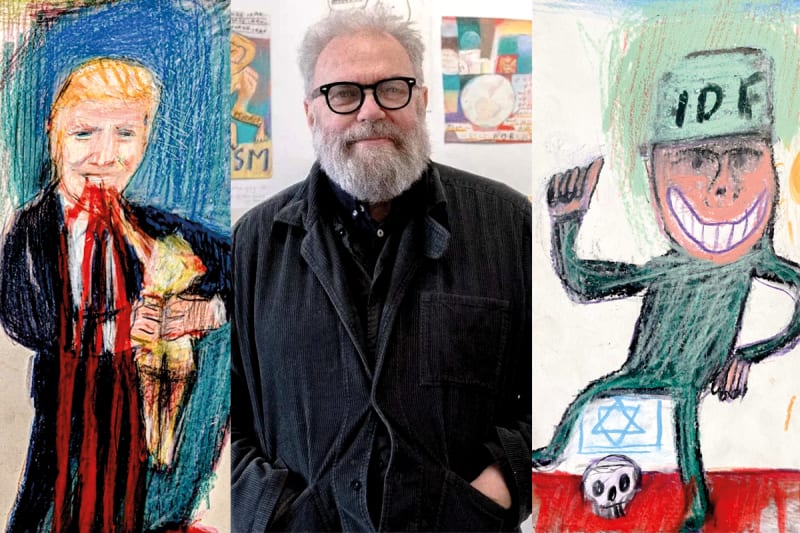
The exhibition comprises 130 drawings showing violence against Palestinians, with military and political leaders surrounded by blood, and Israeli soldiers alongside skulls. It debuted at Joseph Wales Studios in Margate earlier this year.
Earlier this week, a UN commission of inquiry concluded that Israel had deliberately targeted Palestinian children as part of “the crime of genocide, crimes against humanity, and war crimes in the Gaza Strip, and war crimes in the West Bank, including East Jerusalem”.
Merz Gallery director Dr David Rushton said it is “important that galleries should not be held answerable to property owners and councils, and must be free to stand by artists who are prepared to hold truth to power”.
The gallery will also exhibit Scottish artist Jane Frere’s Erasure. The 2017 work – murals filling two walls highlighting the rise of the extreme right – was controversially altered by Edinburgh’s Summerhall Arts management last year to remove references to Nazis and a swastika symbol.
“Ironically it reminded me of how the Nazis removed modern art which they considered ‘degenerate’ in the 30s,” Frere said.
Rushton said the upcoming exhibition “features two important strands of current art activity: one very immediate and urgent, strengthening response to the genocide in Gaza and now in Lebanon. The second, a broader response to how media has cultivated and engaged right-wing interventions to suppress cultural activity and freedom of speech.”
The exhibition of Collings and Frere’s works will be held at Merz Gallery, on Queens Road in Sanquhar, from July 3-5. Collings is due to speak at the opening on July 3 at 5pm.
Interview with anti-Zionist artist Matthew Collings on ‘Drawings Against Genocide’
28 May 2026
Enrique Rodríguez Pámanes Art and literature, Culture and reviews, Palestine movement Articles, Issue 47
“I was always good at art,” Matthew Collings told me over coffee this past week. “When people saw me do clever little drawings, they said, ah, he’ll go far.”
But Collings had an upbringing unlike virtually any other UK art figure, being taken away from his mentally-unwell mother at a young age.
“I spent many years in a children’s home in a very grim part of Kent. I was abused and lived a very very horrifying existence.”
There isn’t much about Collings that says “art world insider.” He carries none of the pomp or self-importance, but sports a big Karl Marx beard, is incredibly friendly, and is fiercely devoted to the Palestinian cause.
The early suffering Collings experienced shaped what he calls his “natural sympathy for trying to fight the suffering of others by psychotic bullies.”
Collings would have ended up the same way millions of other disaffected working-class kids have, if it weren’t for Dr. Rachel Pinney, who was a lesbian, communist, and peace activist. Dr. Pinney pioneered novel therapeutic approaches for children, looked after Collings when he was in the boys home, and encouraged him to pursue art.
“She’d just tell me stuff about, you know, Winston Churchill is bad, and patriarchy fucks everybody up.”
After a foiled attempt to run away abroad, Collings continued to live a tortured life in Kent – until he went to art school, eventually editing an art magazine named Artscribe.
From there he was involved as a producer and presenter on BBC, Channel 2, and Channel 4, making shows popularizing art for an everyday audience, as well as authoring several books on art. His BBC series Renaissance Revolution covers the works of Raphael, Piero, and Hieronymous Bosch.
“I was very established as a sort of person in the world of commentary,” he told us.
Anti-Zionism
Pro-Palestine sentiment is and always has been in short supply in the art world, which is often dominated by Zionist influence and a drive to preserve state funding. So why does Collings stand out?
“The first time I heard the word Zionism was when I dated the daughter of a very important anti-Zionist and survivor of the camps, called Rudy Vrba.”
Vrba escaped Auschwitz in 1944 and co-wrote the Vrba-Wetzler report, detailing the mass murders in the camps. Vrba blamed Hungarian Zionist leaders for collaborating with Eichman, who exchanged the deportation of Jews to save a small group of Zionists.
Upon arriving in Israel after the war, Vrba found some of the same Zionist leaders he deemed responsible for the betrayal in positions of power, which disgusted him and influenced his decision to move to Britain.
Collings’ conviction grew when he met his wife in the 90s, who was a member of the Socialist Workers Party.
“She used to walk out of dinner parties when middle-class TV people I knew would sort of casually be Islamophobic.”
The Corbyn movement radicalized him further, a key point being when notorious pro-Israel Labour MP John Mann attacked Ken Livingstone, saying he was an antisemite. “When I saw the weaponization of antisemitism, I started to understand what the role of Israel in Britain was.”
Collings sees Israel as “a bunch of terrorists who the West enabled to have a state because it was convenient to them,” adding that “genocide is in the DNA of Zionism.”
Collings was aware how support for Palestine and criticism of Israel was suppressed in the art world. But he could not stand idly by. “To be okay with a mass slaughter is to be personally stunted,” he said. “There’s something very wrong with you if you can be indifferent to torture and death”
Collings’ drawings cover historical art figures, satire, and current events. After October 7, 2023, he began a series dealing directly with the genocide in Palestine.
A group of activists for Art For a Free Palestine called Collings and asked if they could exhibit these drawings in Margate, which Collings’ was happy to oblige, calling the series Drawings Against Genocide.
Collings’ drawings are made with coloured pencil and pastel, and are colurful to a near garish degree. They include depictions of the genocide, politicians covered in blood, and IDF soldiers murdering with joy.
The scenes may appear brutish and haphazard, but a closer look shows Collings’ trained eye, which carefully balances each drawing to deliver a calculated punch.
In one scene, Trump is ripping apart a body in the style of Saturn Devouring His Son by Francisco Goya. “I think the whole mood is influenced by Goya,” said Collings. “I have absorbed his sense of cruel, ironic, black humour.”
Goya lived through a world not unlike ours. He personally witnessed the effects of the Peninsula war, which was characterized by ferocious violence on civilians. “He lived through bewildering violence, and the richness of his art reflects all the complexities of societal change and violence, the role of violence in societal change.”
Collings, in a similar way to Goya’s The Disasters of War sketches, deploys an almost journalistic approach to the chaos surrounding us, taking cues from current events and popular imagery.
Zionist attacks
The exhibit was held this March in Margate at the Joseph Wales gallery, which is run by Heidi Rogers. It came under attack before it even opened.
The websites of Rogers, Collings, and his wife were cyberattacked and taken offline. A group named UK Lawyers for Israel sent legal threats to the gallery, which were luckily ignored by Rogers.
“And then while people were milling around, I noticed a person much more expensively dressed than everybody else.” This was, unbeknownst to Collings, Zionist writer Zoe Strimpel.
She began to berate Collings, calling him and his art antisemitic. Bewildered, Collings very calmly explained his art was not antisemitic, but anti-Zionist. Anyone who’s ever argued with one of these people can understand the Sisyphean task of dealing with their level of cognitive dissonance.
Strimpel then went to the police to report the exhibit for being antisemitic. We can imagine her surprise when the police (no friend of the working class) told her that anti-Zionism did not equate antisemitism, and to please stop wasting their time.
Strimpel would go on to write piece after piece about the exhibit, including Lovely time in Margate? No, it was dripping with Jew-hate, saying the exhibit “should be preserved in the annals of anti-Semitic propaganda alongside that of Der Stürmer.”
“The Israeli army is depicted with equally erotically charged levels of dehumanisation, such as the one that shows a soldier-ghoul atop a star of David, stamping on a skull,” she said.
This “proof” of antisemitism is a real scene perpetrated by the IDF in Gaza. But Collings’ hadn’t even seen this photo before making the piece, saying “that drawing is just my iconic, imaginative idea because they kill people and delight in it.”
“Why do I draw IDF soldiers covered in blood and surrounded by skulls? Because the fuckers are covered in blood and surrounded by skulls.”
The smears and slander did not work on the Margate show, but when another exhibit was planned in London, it was successfully shut down by UKLFI. Collings and Art for a Free Palestine are currently looking for another venue to show his drawings.
Uphill battle
This type of art is an uphill battle around the world. Many institutions are more worried about their funding than any type of art which challenges the ruling ideas of the ruling class, which are unabashedly pro-Zionist.
Collings has lost writing gigs for publications like the Evening Standard and Art Review – where he’d been contributing for years – for his support for Corbyn and Palestine, and his opposition to Israel.
There are many artists fighting the same struggle as Collings, like Nan Goldin and Candice Breitz. But what disappoints him the most are the well-known artists who approach him in hushed tones and profess they’re pro-Palestine, while never daring to say it publically. “That’s even worse in a way,” he says. “They’re just obeying orders.”
What also worries Collings is the stranglehold Zionism has on our political system. He ran for parliamentary candidate for Labour in 2019 and was voted in. In the General election of 2024 he would have been standing against Liz Truss. But he was suspended by the Labour Party for claiming Israel controls British politicians, and describing chief rabbi Jonathan Sacks as a “notorious hate-filled racist.”
The exact same tactics would go to be used against Jeremy Corbyn and his suppor
ters to scuttle his election campaign.
Collings sees the unwillingness of Corbyn to fight antisemitism slanders as one of his greatest mistakes, and he refuses to retreat in the face of the same attacks. Today, he sees those same mistakes being replicated in the Green Party.
“There’s a powerful Zionist element within the Greens,” he said, speaking on the undemocratic blocking of the extremely popular “Zionism is Racism” motion at their conference in March.
As far as Collings is concerned, the fight has only just begun, and he’s not stopping any time soon. “The repression is very extreme now precisely because the Zionists know that the whole world sees through them,” he said.
“If you don’t do anything then nothing will happen. You’ve got to do things in the face of the dark days and in the face of repression, and it’s frankly not hard to fight those idiots. They are on the whole pretty stupid.”
Art and revolution
We ended our meeting discussing Trotsky’s writings on art and revolution. Trotsky said art was both a mirror to reflect society, and a hammer with which to shape it. Artists, especially today, cannot afford to sit out the class struggle. Their very existence depends on it.
“Lenin says art has to obey the laws of art before it’s effective as a message,” Collings said. “In other words, he’s saying art has to be good before it’s really effective. There’s a connection between art’s beauty, and its quality and impact.”
Marx was interested in the point of every kind of production. He wrote that the point of art was to create an artistic & beauty-enjoying public — “Production thus produces not only an object for the individual but an individual for the object.”
He added that while art can be useful as propaganda, it’s much more than that. It’s necessary for anyone to live a fulfilled life.
Collings may have made a career off popularizing art to mainstream audiences, but it’s his work depicting the crimes of Israel and fighting Zionism at home which are most needed today.
ESPAÑOL
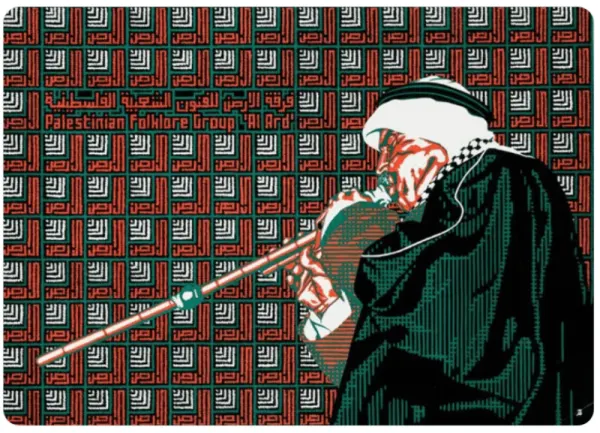
Al Ard — “The Land” — Palestinian folklore group. Al Ard - The Land- La Tierra. Grupo de folklore palestino
Publicado hace 2 días.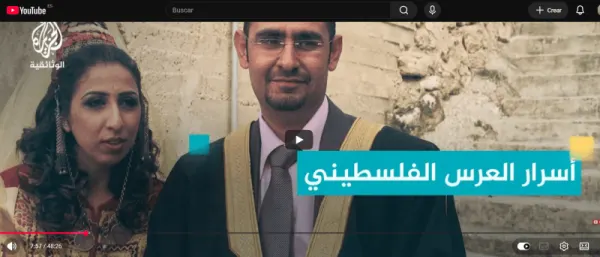
تغاريد عرس فلسطيني.. حكاية تراث لا يموت Preparativos, canciones de boda palestina: Un documental/relato de patrimonio perdurable
Publicado hace 2 días.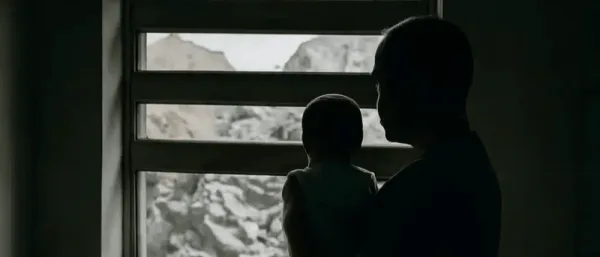
Citizen Osama. Documental
Publicado hace 3 días.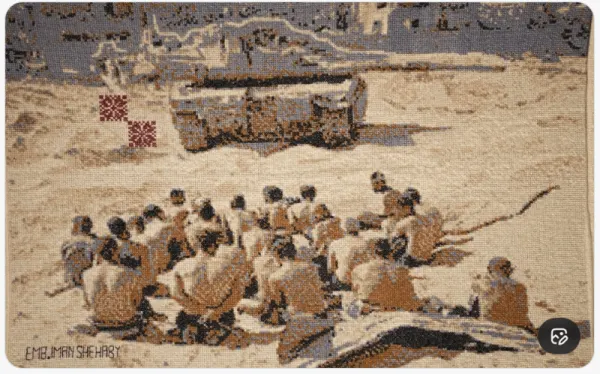
"Gaza. No words" Exhibition Venice. Gaza, sin palabras. Exposición Venecia. ENG ESP
Publicado hace 10 días.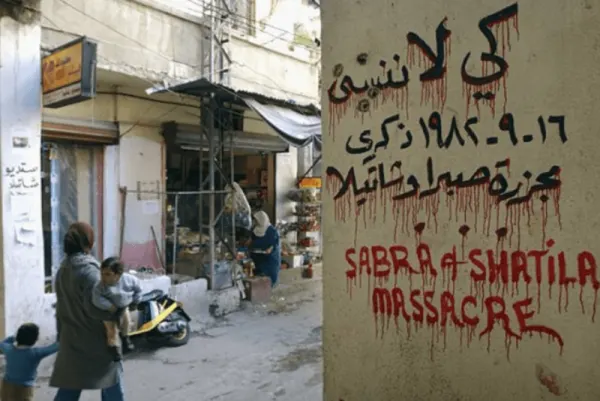
"Moving towards home". June Jordan. 44 years since the Sabra and Sathila massacres. "Camino al hogar"- 44 años desde la masacre de Sabra y Sathila. ENG ESP
Publicado hace 12 días.
Palestine, war of memory. Palestina, memoria de guerra.
Publicado el 11 de septiembre.
Naza ("No other land"), documental, el genocidio de Gaza desde una sala de exterminio con aire acondicionado
Publicado el 11 de septiembre.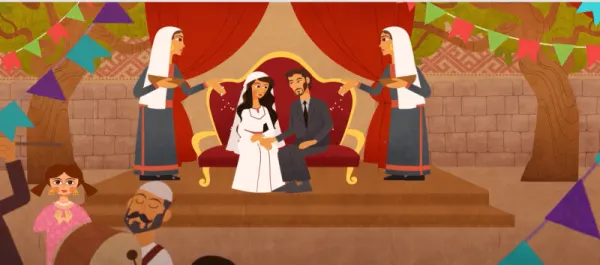
"All we have" Palestinian animation film. "Todo lo que tenemos" dibujos animados palestinos. ENG ESP
Publicado el 3 de septiembre.Ver más / See more
