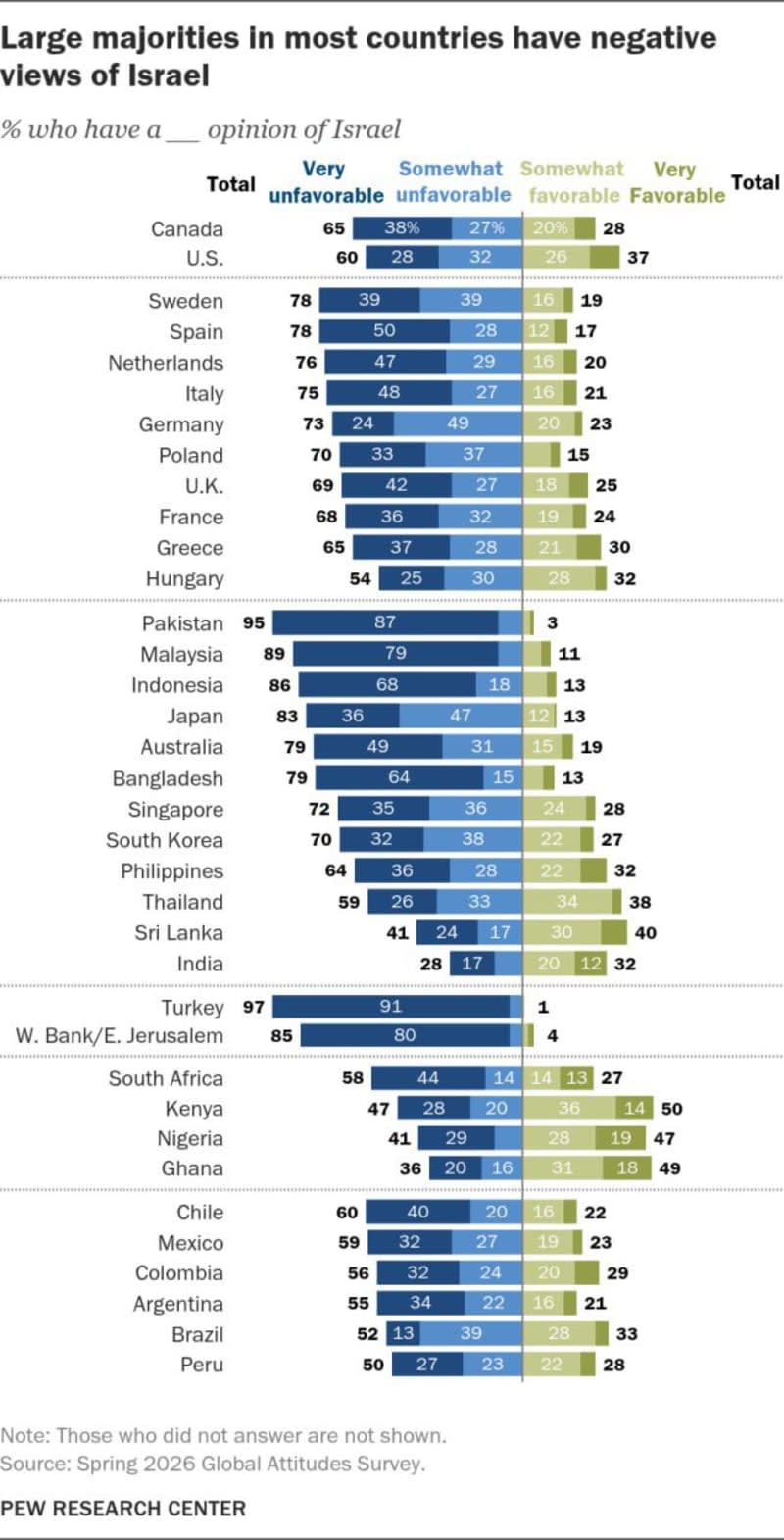
36 countries: a median of 67% of adults hold an unfavorable view of Israel. El 67% de los adultos de 36 países tiene una imagen negativa de Israel. ENG ESP
The Israel state’s favorability rating is declining rapidly. Rápido declive de la valoración positiva de Israel.
Pew poll of 36 countries finds declining support for Israel
Across the countries Pew examined, a median of 67% of adults hold an unfavorable view of Israel while just 25% have a favorable view.
A Pew Research Center poll released on Thursday Jun. 4, 2026 found that most people in 36 countries around the world have a negative view of Israel and that in many of those countries, the Zionist state’s favorability rating is declining rapidly.
While public sentiment toward Israel was already fairly negative last year, unfavorable views have become more common in 13 of the 24 countries where we have trend data. In Argentina, for example, a 46% minority had an unfavorable view of Israel in 2025. Today, it’s a 55% majority.
In Australia, Italy, Nigeria, Poland and the United Kingdom, the shares with very unfavorable views have also increased by double digits.
Only in Greece have views of Israel warmed since last year. Still, just 30% of Greeks express a positive opinion of the country today.
Views are particularly negative in the Muslim-majority places surveyed, including Bangladesh, Indonesia, Malaysia, Pakistan, Turkey, and the West Bank and East Jerusalem. (We were unable to survey in Gaza.)
People in all European countries surveyed also give relatively negative assessments of Israel. In Italy, the Netherlands and Spain, around half of adults or more say they have a very unfavorable view of the country.
Views of Israel are among the most positive in some of the sub-Saharan African countries surveyed.
Across the countries Pew examined, which include both close partners of Israel like the United States and Hungary and hostile states like Pakistan, a median of 67% of adults hold an unfavorable view of Israel while just 25% have a favorable one.
Of the 24 countries where Pew asked the same question in 2025, only Greece saw a marginal improvement in its favorability of Israel.
In 13 of those countries, unfavorable opinions of Israel have become more common.
The number of adults saying that they now hold an unfavorable view of Israel compared to a year ago jumped by 10 percentage points in South Korea; nine percentage points in Argentina, Germany, Italy and Nigeria; eight percentage points in Poland and the United Kingdom; seven in the United States; six in Indonesia and South Africa; five in Australia and Canada; and four in Turkey.
In several countries – mostly in North America and Europe – younger people have more negative views of Israel than older people do. In Hungary, for example, 72% of those ages 18 to 34 have an unfavorable view of Israel, compared with 45% of those ages 50 and older.
“People in all European countries surveyed also give relatively negative assessments of Israel,” Pew stated. “In Italy, the Netherlands and Spain, around half of adults or more say they have a very unfavorable view of the country.”
Pew found that respondents’ views of Israel often tracked the left-right ideological divide, with those on the left having more negative views of Israel and those on the right a more positive view.
“This gap is widest in the U.S.: 83% of liberals and 37% of conservatives have an unfavorable view of the country,” the researchers wrote. “In Australia, Greece, Italy, the Netherlands, Spain and Sweden, around nine-in-10 or more among the left have a negative view of Israel.”
“In each of these nations, that share is at least 23 percentage points higher than it is among those on the right,” they wrote.
Pew surveyed 44,657 people across 36 countries from Feb. 8 to May 13 as part of its global attitudes survey. The margin of error for its findings varies by country.
More than half of adults in countries including Australia, Canada, France, Germany, Greece, Italy, the Netherlands, Spain, Sweden and the United Kingdom report having “no confidence at all” in Netanyahu’s judgment.
As with Israel’s overall favorability, the decline in opinion regarding Netanyahu has been sharpest in South Korea.
ESPAÑOL

Just 37% of Jewish Americans Identify as Zionists. Sólo 37% de los judíos de EEUU se identifican como sionistas. ENG ESP
The youngest age group, 18-34 year olds, were the most likely to identify as Anti-Zionist (14%). Los más jóvenes, los más anti-sionistas.
Publicado hoy.
A Brief History of Anti-Zionist Jews. Una síntesis histórica del judaismo anti-sionista. ENG ESP
¿The solution? To create a socialist Palestine. ¿La solución? La creación de una Palestina socialista
Publicado hace 8 días.
Albert Einstein, Hannah Arendt and others. 1948. Letter to the New York Times. Carta al editor.
Israel. An admixture of ultra-nationalism, religious mysticism, and racial superiority. Israel. Mezcla de ultranacionalismo, misticismo religioso y superioridad racial.
Publicado hace 12 días.
Not just the US: How 51 countries armed Israel. Armamento para Israel: no sólo Estados Unidos. ENG ESP
Israel imported military-related goods despite arms restrictions. Israel importa armamento con/sin "embargos"
Publicado hace 14 días.
Manifiesto en defensa de la vida y el derecho a la salud de las poblaciones de Gaza, Cisjordania y Líbano
Manifiesto firmado por organizaciones sanitarias españolas, promovido por la Federación de Asociaciones para la Defensa de la Sanidad Pública
Publicado hace 14 días.
LA NAKBA NO ES PASADO - módulo de educación política sobre la historia de la Nakba
La Nakba es un proyecto. Tenía un plan. Sigue en marcha.
Publicado el 14 de mayo.
Defender la ética médica: Expulsar a la Asociación Médica Israelí (IMA) de la Asociación Médica Mundial (WMA)
La ética médica, los derechos humanos y el derecho a la salud se aplican a todas las personas, sin excepción. ¡Actúa ahora!
Publicado el 12 de mayo.Ver más / See more