

Not just the US: How 51 countries armed Israel. Armamento para Israel: no sólo Estados Unidos. ENG ESP
Israel imported military-related goods despite arms restrictions. Israel importa armamento con/sin "embargos"
ENGLISH
Not just the US: How 51 countries armed Israel
Israel imported military-related goods from six European countries despite arms restrictions.
Six months into a US-brokered ceasefire, Gaza remains under Israeli attacks
Members of the al-Najar family break their fast during the Muslim holy month of Ramadan amid the rubble of destroyed buildings in Gaza City, March 13, 2026 [Jehad Alshrafi/AP Photo]
By Caolán Magee
Published On 23 May 2026
On a cold day in early January 2024, protesters gathered outside the International Court of Justice (ICJ) in The Hague to denounce Israel’s genocidal war on Gaza, then nearly 100 days old.
More than 3,000km (1,864 miles) away, some Palestinians in Gaza followed the proceedings, livestreamed on YouTube, but most were trying to survive Israel’s relentless bombardment.
In nearly eight decades of the Convention on the Prevention and Punishment of the Crime of Genocide, only a handful of cases had ever reached the court. That day, South Africa was asking the world’s highest court to consider whether Israel’s assault on Gaza constituted a genocide - the destruction, in whole or in part, of an ethnic, racial, religious or national group.
Inside the courtroom, Irish lawyer Blinne Ni Ghralaigh, who was representing South Africa, began to speak.
“The international community continues to fail the Palestinian people,” she told the judges, despite Israeli officials’ “dehumanising, genocidal rhetoric” matched by the military actions in Gaza.
“This is the first genocide in history, where its victims are broadcasting their own destruction in real time, in the desperate, so far vain, hope that the world might do something,” she said.
An average of 247 Palestinians were being killed every day, Ni Ghralaigh told the court; 48 mothers, two every hour; more than 117 children daily, five each hour.
She referred to the new acronym used among doctors and aid workers that had emerged from the devastation: WCNSF - wounded child, no surviving family. By that point, more than 7,000 Palestinians had been killed.
“These facts,” Ni Ghralaigh said, “could not present a clearer or more compelling case” for genocide.
On January 26, 2024, the ICJ ruled that there was a plausible risk of genocide in Gaza and ordered provisional measures. Crucially, it reminded all states party to the Genocide Convention, of which there are 153, of their obligations: to act to prevent genocide.
But over the next 22 months, the killing continued. By the time a ceasefire was reached in October 2025, more than 70,000 people had been killed, with some 171,000 injured.
Throughout that period, the weapons to Israel kept flowing.
Weapons exports
A months-long Al Jazeera investigation has found that military-related goods originating from at least 51 countries and self-governing territories continued entering Israel after the ICJ’s warning of a plausible risk of genocide in Gaza.
Based primarily on an analysis of Israeli Tax Authority (ITA) import data between 2022 and 2025, and supported by customs records and freedom of information requests, the investigation traced military supply chains linked to countries across Europe, Asia, North America and South America. All named countries are signatories to the Genocide Convention.
In some cases, the military-related goods originated from countries that had formally imposed arms embargoes on Israel or had partially suspended arms supplies to the country.
In fact, according to the ITA data, arms imports increased after the ICJ ruling, with the largest share falling under the category of munitions.
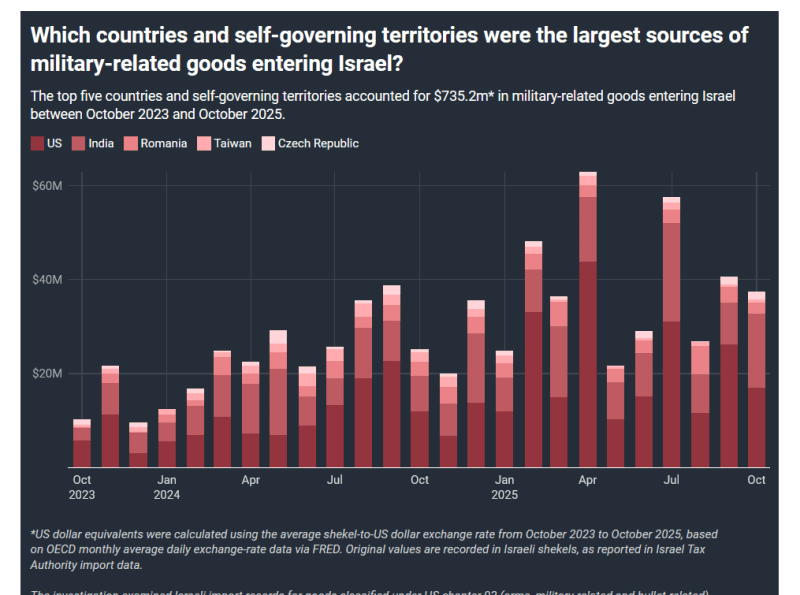
The five largest countries of origin for military-related goods entering Israel - the United States, India, Romania, Taiwan and the Czech Republic - all recorded increased shipments during the war.
While many countries included in this investigation do not share statistics on arms exports to Israel, the ITA data shows that 2,603 consignments of military-related goods - including imports labelled as goods related to ammunition, explosive munitions, weapons parts and armoured vehicle components - entered Israel between October 2023 and October 2025.
In total, the imports were valued at 3.22 billion shekels ($885.6m), with 91 percent of that value recorded after the ICJ’s ruling, according to the ITA data.
By comparison, in the 20 months before October 2023, military-related imports to Israel totalled 1.41 billion shekels ($388.1m). The data suggests Israel increased its dependence on foreign weapons supplies to help sustain its military offensive in Gaza.
Even after the latest ceasefire took effect on October 10, 2025, the flow of weapons did not stop.
In the final two months of 2025, Israel received an additional 324.9 million shekels ($89.4m) in military-related imports, according to the ITA data.
Deputy Attorney General for International Law Gilad Noam, Principal Deputy Legal Adviser of the Ministry of Foreign Affairs of Israel Tamar Kaplan Tourgeman and legal adviser of the Embassy of Israel in the Netherlands Avigail Frisch Ben Avraham look on at the International Court of Justice (ICJ), at the start of a hearing where South Africa requests new emergency measures over Israel's attacks on Rafah, as part of an ongoing case South Africa filed at the ICJ in December last year accusing Israel of violating the Genocide Convention during its offensive against Palestinians in Gaza, in The Hague Netherlands May 16, 2024.
A duty to prevent genocide
Legal scholars say the governments that continued to arm Israel after the ICJ ruling could be complicit in genocide.
Stephen Humphreys, professor of international law at the London School of Economics, told Al Jazeera that even before the ruling, there was “ample evidence that countries arming Israel may be complicit in international crimes, including war crimes and crimes against humanity”.
Gerhard Kemp, a professor of criminal law at the University of the West of England, said Gaza remains the subject of an ongoing genocidal campaign.
“The most recent ‘ceasefire’ did not change this,” he said, pointing to continued military operations, the killing of civilians and the imposition of conditions of life that could destroy the group in whole or in part.
Under the Genocide Convention, states have a duty not only to punish genocide but also to prevent it. Kemp said the obligation is triggered not by a final court ruling but by knowledge of a serious risk.
“Some states have a very narrow understanding of the duty to prevent genocide and are waiting for a judicial determination that there is a genocide in Gaza,” Kemp said. “But the ICJ will likely take several years to make such a determination. The better view is to look at domestic legal obligations ... and international legal obligations and legal tools triggered by available evidence.”
He pointed to the findings of the United Nations Independent International Commission of Inquiry on the Occupied Palestinian Territory, which published a report in September 2025, concluding that Israel “committed a genocide against the Palestinians in Gaza”.
Kemp cited the commission’s conclusion that “states are obliged to take steps to ensure the prevention of conduct that may amount to an act of genocide ... including the transfer of weapons that are used or likely to be used by Israel to commit genocidal acts”.
The report, he acknowledged, was not binding on UN member states. “But it is authoritative regarding existing legal obligations. I think it would be prudent for states to give effect to the commission’s findings and recommendations, especially regarding weapons delivery to Israel,” he said.
Beyond the Genocide Convention, lawyers note, Article 6 of the Arms Trade Treaty prohibits authorising transfers where there is a clear risk the weapons could be used to commit serious violations.
Meanwhile, countries must also contend with their own domestic legal obligations. This includes “laws in the UK and other states that require due diligence in the export of weapons to states potentially or plausibly involved in the commission of international crimes”, Kemp said.
Gaza destruction
Palestinians children amid the destruction caused by an Israeli strike in Khan Younis, southern Gaza Strip, on Tuesday, May 19, 2026 [Abdel Kareem Hana/AP]
Analysing Israeli import data
The ITA maintains a publicly accessible database of imports organised by eight-digit customs codes.
These codes are structured according to the World Customs Organization’s Harmonized System (HS). The first six digits correspond to internationally standardised product categories, while countries are permitted to provide more detailed national statistics by adding digits. In the case of Israel, it often uses eight-digit codes – the global six digits plus two additional digits for national detail.
Al Jazeera analysed more than 6.5 million individual customs entries covering Israeli imports between 2022 and 2025. The investigation focused on imports where customs codes begin with “93”, the HS chapter covering arms and bullet-related exports, as well as code 87100000, which covers tanks and other armoured fighting vehicles and their parts.
According to Israel’s customs codebook, these codes include:
Explosive munitions, such as “bombs, grenades, torpedoes, mines, missiles and similar munitions of war and parts”. It also labels “cartridges”, some types o
In total “ammunition and projectiles” and parts, including “shot and cartridge wads” (93069090)
Items labelled as “bullets” (93069010)
“Parts and accessories” of military weapons, including components for “revolvers and pistols” (93051000)
“Shotguns and rifles” (93052000)
Parts and accessories of military weapons (93059100)
“Other” types of parts and accessories (93059900)
“Rocket launchers, flamethrowers, grenade launchers, torpedo tubes and similar projectors” (93012000)
“Tank and other armoured fighting vehicle, motorised, whether or not fitted with weapons, and parts” (87100000)
What the data shows and what it doesn't
While this dataset provides an unusually detailed picture of Israel’s weapons-related imports during the war, it represents only a partial view of total arms transfers.
The customs records do not specify the exact nature of the item, the final recipient or the end user of the items shipped.
The data records an “origin country” for imported goods, but this does not necessarily mean the items were exported directly from that country into Israel. They may instead have been routed through third countries.
In many international arms supply chains, military-related components are incorporated into wider weapons systems or transferred between manufacturers before ultimately reaching their final destination.
Arms experts told Al Jazeera that many governments assess the intended end user of military-related goods before approving exports, but do not systematically conduct post-shipment verification overseas to determine how components are ultimately used once transferred through international supply chains.
However, all goods recorded under these codes are classified as military-related under the Israeli import system.
In some instances, weapons experts say, the military equipment may be used for training purposes.
The data also records the point of entry for each shipment, including Ben Gurion airport, ports of Haifa and Ashdod, and the Jordan River crossing.
Al Jazeera’s analysis does not include weapons supplied to Israel free of charge, military aircraft or jet parts, and strategic communications or radar systems.
Weapons experts consulted by Al Jazeera said these categories are often recorded under broad customs headings that can, in some cases, include civilian goods among military exports – for example, with aircraft parts used in commercial aviation – making it impossible to determine with confidence whether such shipments were military in nature.
For that reason, Al Jazeera excluded customs codes where the military-related nature of the goods could not be established with sufficient certainty.
Gaza destruction
A Palestinian examines the remains of a missile which hit a family home during an Israeli airstrike in Deir al-Balah, in the central Gaza Strip, on Friday, January 16, 2026 [File: Abdel Kareem Hana/AP]
What HS code 93 means in practice
Because the Israeli import dataset does not specify precise models or end users, Al Jazeera sought independent documentation to test whether shipments recorded under HS codes beginning with “93” correspond to identifiable weapons components moving between named defence companies.
Al Jazeera obtained 91 Indian customs export documents covering arms-related shipments to Israel in 2024 under the classification code 93069000.
HS code 9306 refers to “bombs, grenades, torpedoes, mines, missiles and similar munitions of war, and parts thereof”. The Indian subcategory 93069000 is labelled “bombs, grenades”, according to India’s Ministry of Commerce and Industry’s customs book.
The documents show Indian firms exporting weapons components to Israeli arms manufacturers, including Rafael Advanced Defense Systems, IMI Systems Limited and MCT Materials.
Across multiple consignments, Kalyani Rafael Advanced Systems Private Limited (KRAS) – a joint venture between India’s Kalyani Strategic Systems and Israel's Rafael Advanced Defense Systems – exported a combined total of 554,120 units described as “HEAVY FRAG” components to Rafael Advanced Defense Systems. Arms specialists who reviewed the records said fragmentation components are typically used in explosive munitions that disperse metal fragments upon detonation.
Kalyani Strategic Systems, the Indian partner that holds a majority stake in KRAS, exported 50 units labelled “155MM PROJECTILE BODY” to IMI Systems. Weapons experts said a 155mm projectile body is the main steel casing of a large artillery shell, designed to be filled with explosives.
Economic Explosives Limited (India) exported 99,400 units described as “booster pellet (munitions, defence)” to Reshef Technologies Limited in Israel. Experts said booster pellets are used to initiate larger explosive charges in military munitions.
Other shipments included 320 units described as “munition metal parts”, exported by Ashoka Manufacturing Private Limited to MCT Materials.
....
....
Spain
Under Prime Minister Pedro Sanchez, Spain became one of Israel’s most vocal critics in the EU, calling for a ceasefire and backing international legal action.
In January 2024, Spain’s foreign minister said the country had not sold any weapons to Israel since the start of the war, insisting an embargo was already in effect. But a legally binding embargo was not written into law until October 2025, the month the latest "ceasefire" was announced.
Israeli customs data reviewed by Al Jazeera recorded 99 shipments of military-related goods originating from Spain worth 21.6 million shekels ($5.9m) by then. Its largest consignment, 4 million shekels ($1.1m) labelled under the HS code for explosive-type munitions, entered Israel in December 2023.
Al Jazeera contacted the Spanish government for comment, but had received no response at the time of publication.
....
....
ESPAÑOL

SPAIN. Boycott Teva. October 2026. Update. ESPAÑA. Boicot a Teva. Resumen. Octubre 2026. Actualización. ENG ESP
No one is "innocent," not even Spain. Nadie es "inocente", tampoco España.
Publicado hoy.
Vall d'Hebron Institut de Recerca (VHIR), Barcelona, España, y sus conflictos de interés con Teva. Vall d'Hebron Institute of Research (VHIR), Barcelona, Spain, and its conflicts of interest with Teva. ESP ENG
Dinero (de Teva España) e influencia (de Teva Israel). Money (from Teva Spain) and influence (from Teva Israel).
Publicado hace 6 días.
“Resist by all available means—armed resistance, cultural resistance and economic resistance.” «Resistir por todos los medios disponibles: resistencia armada, resistencia cultural y resistencia económica». ENG ESP
Breaking the Taboo: Palestine and Armed Resistance. Sin tabués: la resistencia armada palestina.
Publicado el 17 de septiembre.
Asier y Youssef, miembros de ‘Iranekin Bat’ y Samidoun detenidos y procesados en la Audiencia Nacional.
"Si Youssef y Asier son terroristas, yo también soy terrorista”
Publicado el 11 de septiembre.
1060 días de horror. 2 septiembre 2026. Spanish Revolution
La obscenidad también consiste en eso: convertir una carnicería diaria en ruido de fondo.
Publicado el 7 de septiembre.
Israel quiere "borrar" a los palestinos de Palestina. Israel wants to "erase" the Palestinians from Palestine. ESP ENG
Israel busca crear un pueblo de muertos vivientes que emigren "voluntariamente". O una matanza brutal. Israel seeks to create a nation of the living dead who emigrate "voluntarily." Or a brutal massacre.
Publicado el 3 de septiembre.
USA support of Israel. The unmatched power of the Israel Lobby. El apoyo de Estados Unidos a Israel. El poder sin parangón del lobby israelí. ENG ESP
Israel has infected the United States through the Israeli lobby and turned it into a zombie that acts in Israel's own best interests. Israel ha infectado Estados Unidos a través del lobby israelí y lo ha convertido en un zombi que actúa en favor del propio Israel
Publicado el 29 de agosto.
Convocatoria en Rotterdam, 8-10 octubre 2026, campaña fondos: Asociación Médica Israelí (IMA) fuera de la Asociación Médica Mundial (WMA). Meeting in Rotterdam, October 8-10, 2026, fundraising campaign: Israeli Medical Association out of the World Medical Association. ESP ENG
Por ética y dignidad la IMA fuera de la WMA. Uphold medical ethics, IMA out of WMA
Publicado el 29 de agosto.Ver más / See more
