

Ten Stages of genocide. Las 10 etapas del genocidio. ENG ESP
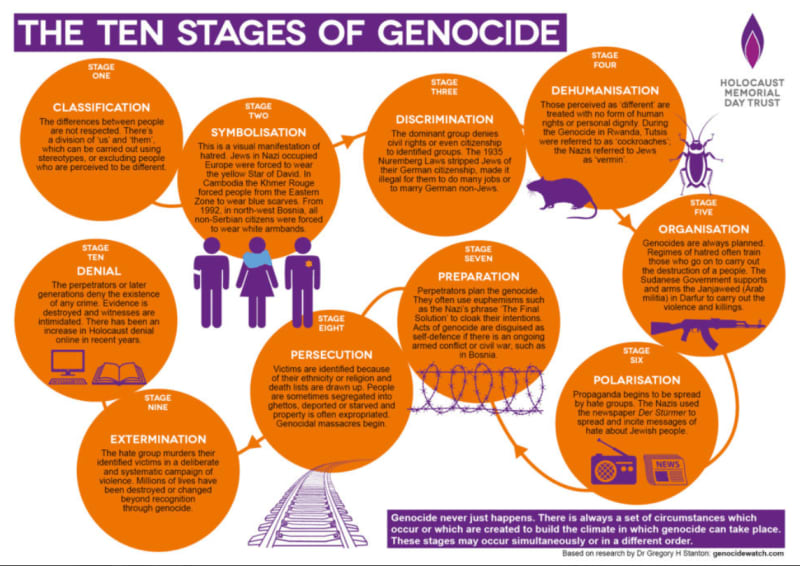
A model to understand the "logic" of genocide. Un modelo para entender la "lógica" del genocidio
ENGLISH
GENOCIDE WATCH
Genocide is a process that develops in ten stages that are predictable but not inexorable. At each stage, preventive measures can stop it. The process is not linear. Stages occur simultaneously. Each stage is itself a process. Their logic is similar to a nested Russian matryoshka doll. Classification is at the center. Without it the processes around it could not occur. As societies develop more and more genocidal processes, they get nearer to genocide.
[Palestine is now in the stage 9, extermination]
But all stages continue to operate throughout the process.
Ten stages of genocide:
I. Classification
ii. Symbolization
iii. Discrimination
iv. Dehumanization
v. Organization
vi. Polariz3Q0nW1kmeysation
vii. Preparation
viii. Persecution
ix. Extermination
x. Denial
The Logic of the Ten Stages of Genocide
By Dr. Gregory Stanton
Founding President, Genocide Watch
In my studies of genocide, I discovered that the process of every genocide has predictable "stages" or processes. After studying the history of the Holocaust, the Armenian Genocide, the Cambodian Genocide, and other genocides, in 1987 I developed a model known as the Ten Stages of Genocide. I regret using the term "stages" because the word "stages" implies linearity. The processes of genocide aren’t linear because they usually operate simultaneously. I should have simply called the "stages" processes. But there is a logical order to them. The processes are logically related to each other. Discrimination cannot occur without Classification, for example.
The relationship between the processes is like the figures in a Russian Matryoshka "nesting doll" in which an original leader's figure is at the center, and later leaders' figures nest outwards until we reach the figure of the current leader on the outside. The processes are also like the rods that are inserted into a nuclear reactor. As they are pushed in deeper along with other rods, a nuclear reaction results.
This theory of fundamental processes is based on the structuralist theories of Jean Piaget. By observing the development of his own and other children, Piaget noted fundamental cognitive and moral processes that are transformed in a predictable order in each child's development. Piaget showed how cognitive processes are directly related to moral processes. At Harvard I studied the work of Lawrence Kohlberg, a follower of Piaget's theories who used moral dilemmas to reveal the fundamental processes of moral reasoning. His work has proved powerful in analyzing people's explanations for their decisions. I also studied with Prof. James Fowler, who showed how Piaget's cognitive stages inform stages of faith.
Anthropologists look for the fundamental structures in human societies and cultures. When I studied anthropology at Chicago, I saw that socio-cultural processes are also structured. Van Gennep showed that the structure of rites of passage is similar in many cultures. Marcel Mauss did the same for sacrifice. Professor Victor Turner taught me that rituals and symbols are keys to understanding social, political, psychological, and religious structures. These rituals often use the same symbols in many cultures- fire, water, blood, crosses, meals.
I wrote my master’s thesis on the movie, "The Graduate." In it I showed that the film uses the structure and symbols discovered by Van Gennep for rites of passage. I wrote a grammar for the film using Noam Chomsky's theories of transformational grammars.
When I began my work in genocide studies in Cambodia, I realized there are also fundamental operations - processes - that occur in genocides. I looked for transformational processes that re-order and change societies. I first identified the "stages of genocide" in 1987 by comparing the Cambodian genocide with the Holocaust and the Armenian genocide. I looked for fundamental processes that led to those genocides. They are the socio-cultural processes that interact to transform a society into one that developed into genocide. In 1994, the same processes drove the Rwandan Genocide.
Many people now know "The Ten Stages of Genocide" model I developed. I never expected it to be so widely used. But the Ten Stages were not brought down from Mount Sinai on a stone tablet. When I first wrote the model, it had eight stages. Colleagues suggested two more, which I added in 2012. There are undoubtedly other processes that I haven't thought of. It's only a model.
The model has proven useful to look for these processes because they help us see when genocide is coming and what governments can do to prevent it.
For those unfamiliar with the model, here it is, briefly: [Note that most of the names for the processes end in "-ation", the English ending for words describing processes.]
→ The first process is Classification, when we classify the world into us versus them.
→ The second is Symbolization, when we give names to those classifications like Jew and Aryan, Hutu and Tutsi, Turk and Armenian, Bengali and Pashtun. Sometimes the symbols are physical, like the Nazi yellow star.
→ The third is Discrimination, when laws and customs prevent groups of people from exercising their full rights as citizens or as human beings.
→ The fourth is Dehumanization, when perpetrators call their victims rats, or cockroaches, cancer, or disease. Portraying them as non-human makes eliminating them a “cleansing” of the society, rather than murder.
These first four processes taken together result in what James Waller calls "Othering."
→ The fifth process is Organization, when hate groups, armies, and militias organize.
→ The sixth is Polarization, when moderates are targeted who could stop the process of division, especially moderates from the perpetrators’ group.
→ The seventh process is Preparation, when plans for killing and deportation are made by leaders, and perpetrators are trained and armed.
→The eighth process is Persecution, when victims are identified, arrested, transported, and concentrated into prisons, ghettos, or concentration camps, where they are tortured and murdered.
→ The ninth process is Extermination, what lawyers define as genocide, the intentional destruction, in whole or in part, of a national, ethnic, racial, or religious group.
When I outlined “the stages of genocide" in a memo I wrote in the State Department in 1996, I realized there is another process in every genocide:
→ Denial. Denial is a continuation of a genocide, because it is a continuing attempt to destroy the victim group psychologically and culturally, to deny its members even the memory of the murders of their relatives.
This processual model demonstrates that there is a logic to the genocidal process, though the relationships between the processes are not linear. The "stages" are processes that occur simultaneously.
By helping us understand the logic of genocide, people can see the early warning signs of genocide and know when it is coming. Leaders can design policies to counteract the forces that drive each of the stages.
This stage model of the genocidal process was first set forth in 1987 in the Faulds Lecture at Warren Wilson College, "Blue Scarves and Yellow Stars: Classification and Symbolization in the Cambodian Genocide." The model was presented as a briefing paper, “The Eight Stages of Genocide” at the US State Department in 1996. Discrimination and Persecution have been added to the 1996 model.
I am grateful to many people for improvements in my original eight stage model, especially to Prof. Alan Whitehorn of the Royal Military College of Canada, and Prof. Elisa von Jöeden-Forgey for noting the gendered aspects of genocides.
No model is ever perfect. All are merely ideal-typical representations of reality that are meant to help us think more clearly about social and cultural processes. It is important not to confuse any stage with a status. Each stage is a process. It is like a fluctuating point on a thermometer that rises and falls as the social temperature in a potential area of conflict rises and falls. It is crucial not to confuse this model with a linear one. In all genocides, many stages occur simultaneously.
The purpose of this model is to place the risk factors in Barbara Harff’s pioneering analysis of country risks of genocide and politicide into a processual structure.
Risks of political instability are characteristic of what Kuper called “divided societies,” with deep rifts in Classification. Targeted groups of state-led discrimination are victims of Discrimination. An exclusionary ideology is central to Discrimination and Dehumanization. Autocratic regimes foster the Organization of hate groups. An ethnically polarized elite is characteristic of Polarization. Lack of openness to trade and other influences from outside a state’s borders is characteristic of Preparation for genocide or politicide. Massive violation of human rights is evidence of Persecution. Impunity after previous genocides or politicides is evidence of Denial.
Statistical risk models that are used to predict genocide are different from this model because they use abstract variables constructed with indicators that can be counted or estimated. They are accurate only if the variables used are correlated with likelihood of genocide. The best risk models are those constructed by the Minority Rights Group and the Australian Targeted Mass Killing Data Set for the Study and Forecasting of Mass Atrocities. They result in annual ranked estimates of the probability of genocide in countries studied.
The Ten Stages of Genocide model is event driven and continuous. It does not produce statistical rankings. It only estimates whether countries should be subjects of Genocide Watches, Warnings, or Emergencies. The model describes the processes that could lead to genocide in a country and actions that should be taken to oppose and slow those processes.
It goes beyond annual statistical risk estimates to describe events that signal warnings of genocidal processes. It is a model to guide policy makers to take actions to prevent and stop genocide. It has been successfully applied by policy makers to prevent or stop genocides in Mozambique, East Timor, Kosovo, Macedonia, Liberia, Cote d'Ivoire, Burundi, Ethiopia, and Kenya. However, when national or world leaders lack the political will to prevent genocide, thousands of people still die.
Ultimately the best antidote to genocide is popular education and the development of social and cultural tolerance for diversity. That is why Genocide Watch and the Alliance Against Genocide hope to educate people around the world to resist genocidal forces whenever they see them. We strongly favor nonviolent resistance to tyranny. We strongly favor the liberation of women. We oppose all war.
Finally the movement that will end genocide must come not from international armed interventions, but rather from popular resistance to every form of discrimination; dehumanization, hate speech, and formation of hate groups; rise of political parties that preach hatred, racism or xenophobia; rule by polarizing elites that advocate exclusionary ideologies; police states that massively violate human rights; closure of borders to international trade or communications; and denial of past genocides or crimes against humanity against victim groups.
The movement that will end genocide in this century must arise from each of us who have the courage to challenge discrimination, hatred, and tyranny. We must never let the wreckage of humanity's barbaric past keep us from envisioning a peaceful future when law and democratic freedom will rule the earth.
For those who doubt there is any direction in history, our common humanity is enough to give meaning to our cause. To those of us who know that history is not some directionless accident, this is our calling and our destiny. As John F. Kennedy said, “On earth, God’s work must truly be our own.”
© 2023 Gregory H. Stanton
ESPAÑOL
Vall d'Hebron Institut de Recerca (VHIR), Barcelona, España, y sus conflictos de interés con Teva. Vall d'Hebron Institute of Research (VHIR), Barcelona, Spain, and its conflicts of interest with Teva. ESP ENG
Dinero (de Teva España) e influencia (de Teva Israel). Money (from Teva Spain) and influence (from Teva Israel).
Publicado hace 2 días.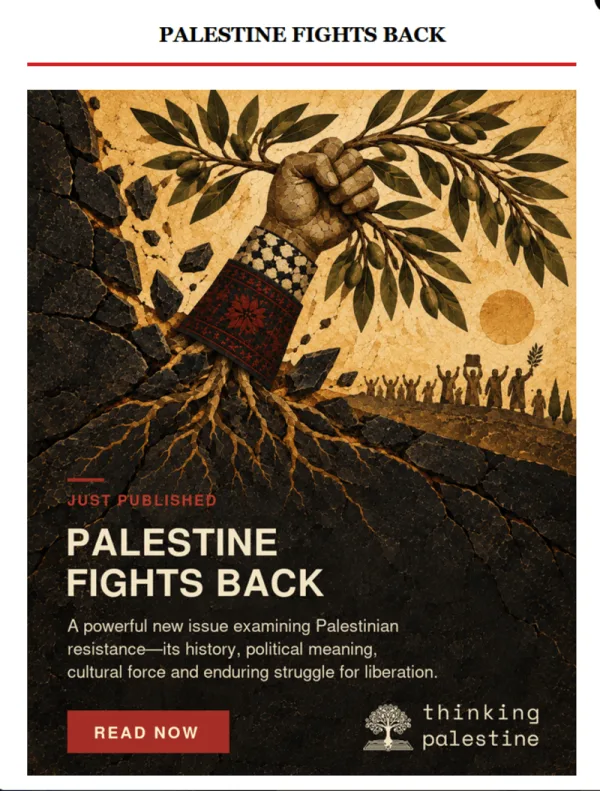
“Resist by all available means—armed resistance, cultural resistance and economic resistance.” «Resistir por todos los medios disponibles: resistencia armada, resistencia cultural y resistencia económica». ENG ESP
Breaking the Taboo: Palestine and Armed Resistance. Sin tabués: la resistencia armada palestina.
Publicado el 17 de septiembre.
Asier y Youssef, miembros de ‘Iranekin Bat’ y Samidoun detenidos y procesados en la Audiencia Nacional.
"Si Youssef y Asier son terroristas, yo también soy terrorista”
Publicado el 11 de septiembre.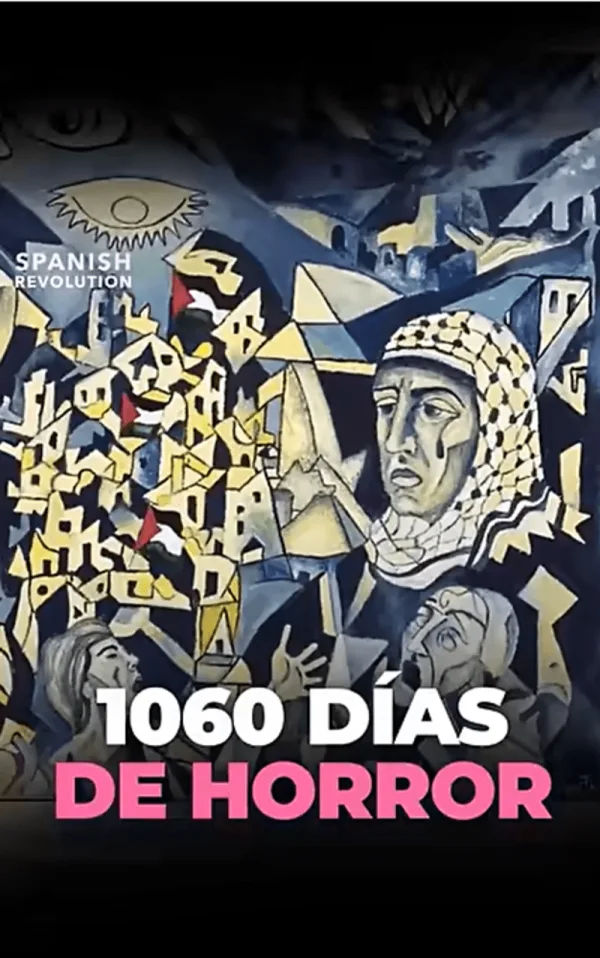
1060 días de horror. 2 septiembre 2026. Spanish Revolution
La obscenidad también consiste en eso: convertir una carnicería diaria en ruido de fondo.
Publicado el 7 de septiembre.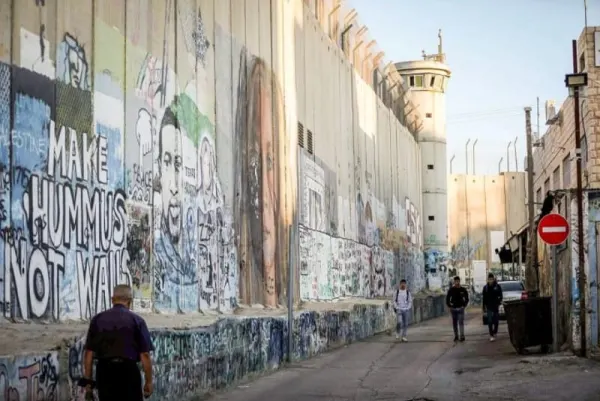
Israel quiere "borrar" a los palestinos de Palestina. Israel wants to "erase" the Palestinians from Palestine. ESP ENG
Israel busca crear un pueblo de muertos vivientes que emigren "voluntariamente". O una matanza brutal. Israel seeks to create a nation of the living dead who emigrate "voluntarily." Or a brutal massacre.
Publicado el 3 de septiembre.
USA support of Israel. The unmatched power of the Israel Lobby. El apoyo de Estados Unidos a Israel. El poder sin parangón del lobby israelí. ENG ESP
Israel has infected the United States through the Israeli lobby and turned it into a zombie that acts in Israel's own best interests. Israel ha infectado Estados Unidos a través del lobby israelí y lo ha convertido en un zombi que actúa en favor del propio Israel
Publicado el 29 de agosto.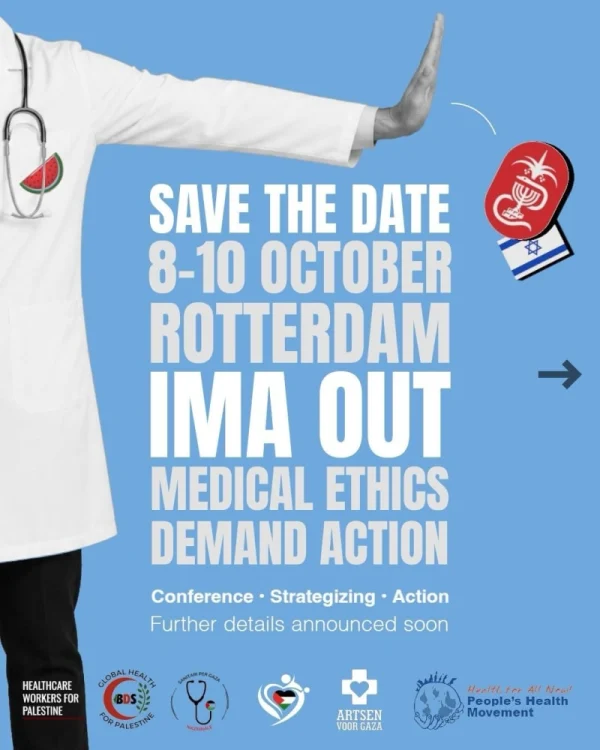
Convocatoria en Rotterdam, 8-10 octubre 2026, campaña fondos: Asociación Médica Israelí (IMA) fuera de la Asociación Médica Mundial (WMA). Meeting in Rotterdam, October 8-10, 2026, fundraising campaign: Israeli Medical Association out of the World Medical Association. ESP ENG
Por ética y dignidad la IMA fuera de la WMA. Uphold medical ethics, IMA out of WMA
Publicado el 29 de agosto.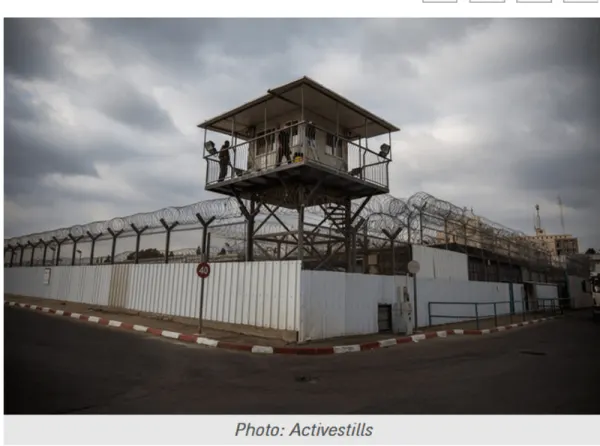
Israeli prisons as machines of Palestinian death. Las cárceles israelíes como máquinas de matar palestinos. ENG ESP
“The logic of the Israeli carceraly system is now one of starvation, beatings, killings” “La lógica del sistema carcelario israelí es ahora de hambrunas, palizas y asesinatos”
Publicado el 24 de agosto.Ver más / See more
