Read firts: Israel vuelve a imponer asedio total a Gaza. Israel reimposes total siege on Gaza. ESP ENG. 28 Feb 2026
Markets Empty in Gaza as Residents Brace for Possible Famine After Crossing Shutdown
Famine rarely announces itself loudly. It does not arrive with a declaration that the world can easily recognize. Instead it approaches gradually through the accumulation of small and seemingly ordinary changes.
A truck that does not come. A stall that stands empty. A meal that cannot be cooked.
Only later, when the suffering becomes undeniable does the world understand that famine had already begun long before anyone spoke its name.
For this reason it is necessary to watch Gaza carefully now.
Because famine never begins with death.
It begins with silence. And that silence has already begun.
March 5, 2026
Gaza City – What began as a routine trip to the market quickly turned into a moment of alarm for many residents across Gaza. As news spread that Israel had struck Iran and that a wider conflict might be unfolding, crowds flooded local markets, rushing to buy basic food supplies amid fears that the territory could once again face shortages and rising prices.
Hani Abu Issa had only planned to purchase a few ingredients for his family’s Ramadan iftar when he arrived at the Deir el-Balah market on Saturday morning. Instead, he found large crowds gathering in front of grocery stores. Curious about the sudden rush, he asked nearby shoppers what was happening. Someone told him that Israel had launched strikes on Iran and that a war had begun.
Within moments, the atmosphere changed. People hurried through the market carrying large sacks of flour, grabbing whatever supplies they could find. In the first hours after the news broke, the markets across Gaza began to fill with residents searching for sugar, flour, cooking oil, and yeast. Shelves started to empty quickly, and the prices of essential goods began climbing.
Hani, a 51-year-old father of five, said he doubts the confrontation between Israel, backed by the United States, and Iran will directly reach Gaza. Still, he admitted that years of war and deprivation have left people deeply anxious about any military developments in the region.
“People are afraid of everything now,” he said while standing among food stalls in the Deir el-Balah market. “Since the morning, everyone rushed to the markets to store food. That caused shortages and drove prices up.”
Concerns grew even stronger later that evening when Israel’s Coordination of Government Activities in the Territories announced on Facebook that crossings into Gaza and the occupied West Bank would be closed “until further notice” because of the regional security situation tied to the conflict with Iran.
For Hani and many others, the possibility that crossings could remain shut is alarming. He explained that basic items like flour, sugar, cooking oil, and yeast were the first to vanish from the shelves due to overwhelming demand.
Having lived through famine conditions during Israel’s devastating war on Gaza, he said the memories remain painful. “There were days when a sack of flour cost more than 1,000 shekels,” he recalled. “I never want to experience that again.”
Even so, Hani believes that stockpiling food cannot truly solve the problem. Supplies disappear quickly, and Gaza’s harsh living conditions can easily spoil stored goods. What residents really need, he said, is reassurance that the crossings will reopen soon.
“We just want someone to tell us that this closure won’t last and that Gaza will not suffer again,” he said.
Local reports suggested that the closure might also be connected to the Jewish holiday of Purim, leaving many people uncertain about how long the restrictions will remain in place.
But Hani said the lack of clarity only deepens public frustration. “No one can confirm anything, and Israel never gave a timeline,” he said. “Gaza hasn’t recovered from two years of war and famine. Sometimes I feel the only thing left is to leave this place and start a new life somewhere else.”
During Ramadan last year, Palestinians in Gaza endured one of the harshest periods of the war after crossings were closed and goods were blocked from entering the territory. Food shortages spread, prices skyrocketed, and famine conditions worsened for many families. Israel’s starvation policy drew strong international condemnation as markets emptied and severe malnutrition claimed lives.
Fear Rooted in Past Trauma
In the Nuseirat market, where crowds were still scrambling for groceries, vendor Omar Al-Ghazali said the memories of famine continue to haunt residents.
“The fear people feel today is completely understandable,” said the 28-year-old father of four. “They remember what happened before and want to protect themselves.”
According to Al-Ghazali, even though the current war is not taking place inside Gaza, the trauma of previous starvation has made people react immediately.
“People try to convince themselves that things will be fine,” he said. “But fear is stronger than logic after what they went through.”
Many Families Cannot Afford to Prepare
Not everyone has the financial ability to stockpile food. In Gaza City’s market, Asmaa Abu Al-Khair walked through the crowded streets on Sunday carrying nothing. The 38-year-old mother of eight said she desperately wants to store supplies but simply cannot afford to.
“Where would we even keep it?” she asked. “And what would we store when we struggle every day just to feed our children during Ramadan?”
She said the news about Iran and the crossing closures has filled the markets w
ith fear, but families like hers are left helpless.
“I’m terrified famine might return,” she said. “But I can’t buy what others are buying.”
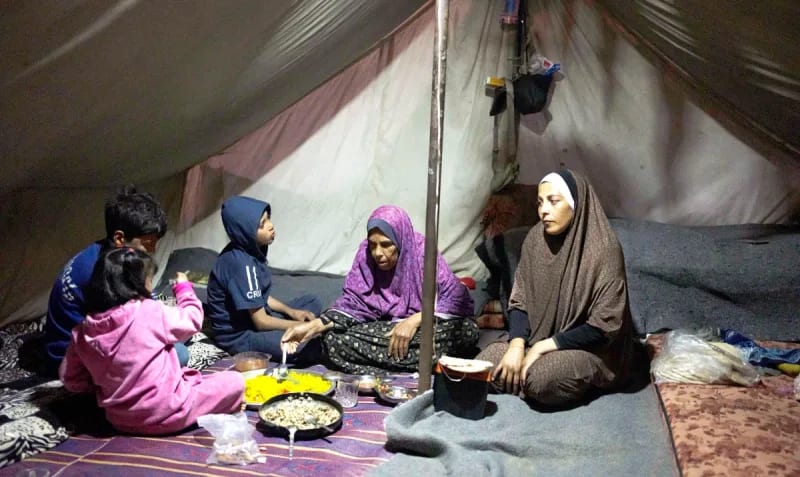
Asmaa added that many displaced families living in nearby tents face the same reality. Without money or space to store food, stockpiling is impossible.
“We went through so much suffering during the war, and we barely started breathing again after the ceasefire,” she said. “So why close the crossings now? What does Gaza have to do with this war?”
When the official closure announcement came, she said the news felt devastating. “It felt like a knife in my heart,” she said. “I went to sleep feeling completely defeated.”
Growing Humanitarian Concerns
Mohammed Daher, a 46-year-old displaced resident from Jabalia now living in Deir el-Balah, said he had finally begun to experience a peaceful Ramadan after two years of war. But the news of the regional conflict and the crossing closures quickly shattered that sense of calm.
“I felt lost again,” he said while walking through the market. Despite the panic around him, Daher chose not to buy extra supplies.
“We are exhausted,” he said. “After everything we’ve endured, I’ve reached a point where I expect the worst.”
Daher believes Israel is using the situation as another pretext to tighten the blockade and deepen Gaza’s humanitarian crisis. During the previous famine, he spent nearly all his savings purchasing basic food items at extreme prices.
“Everything cost as much as gold,” he said. “And sometimes you couldn’t even find it.”
Economic Collapse and Calls for Action
The crossing closures also triggered widespread debate on social media, where Palestinians questioned whether Gaza is entering another harsh phase of isolation and deprivation. Many accused Israel of exploiting the moment to increase pressure on the population while global attention is focused on the war with Iran.
Ali al-Hayek, a member of the Palestinian Businessmen Association in Gaza, warned that keeping the crossings closed could halt humanitarian aid deliveries and disrupt charity kitchens that thousands of families rely on daily.
The restrictions could also prevent urgent medical travel abroad for wounded patients and those suffering from serious illnesses such as cancer.
Al-Hayek noted that Gaza’s economy has already collapsed after years of war. More than 85 percent of economic activity has been destroyed, unemployment has climbed to nearly 80 percent, and over 97 percent of industrial facilities have stopped operating.
He urged the international community to intervene immediately and pressure Israel to reopen the crossings, allowing the movement of people, goods, and humanitarian aid.
At the same time, he called on local traders not to exploit the situation by raising prices. With Ramadan underway, he said, solidarity among Palestinians is more important than ever.


 Available in
  Available in
  Available in
  Available in
  Available in
  Available in
  Available in
  Available in