"Moving towards home". June Jordan. 44 years since the Sabra and Sathila massacres. "Camino al hogar"- 44 años desde la masacre de Sabra y Sathila. ENG ESP
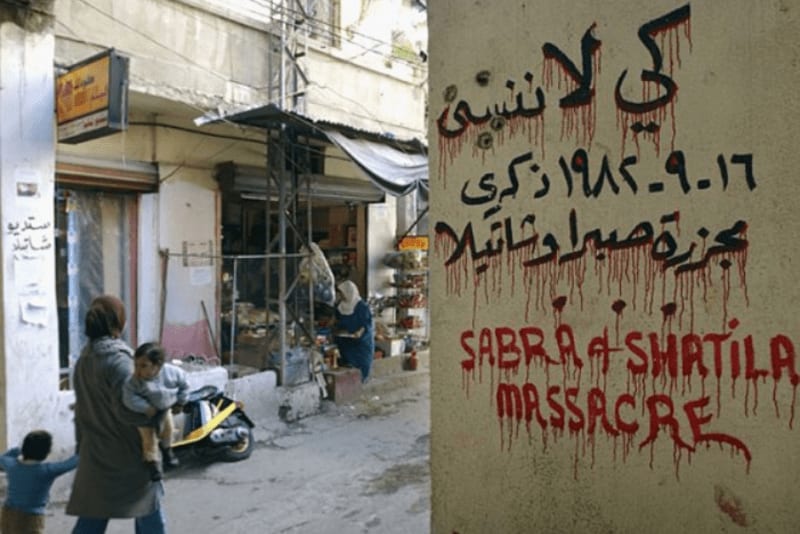
This week marks forty-four years since the Sabra and Shatila massacres in 1982. Shatila is one of the first Palestinian refugee camps established in Lebanon, and was populated predominantly by refugees of the 1948 Nakba. Sabra is a poor neighborhood adjoining the camp. Over the course of 40 continuous hours between 16-18 September, right-wing Lebanese Christian militants, backed by Israel, killed between 2,000 and 3,500 people, mostly Palestinian refugees.
A culmination of the Israeli invasion of Lebanon, which began in June 1982, the Sabra and Shatila massacres represented Ariel Sharon’s attempt to extirpate the Palestine Liberation Organization, or PLO, which was headquartered in Beirut at the time. As the massacre took place, Israeli forces surrounded the Sabra neighborhood and Shatila refugee camps to prevent people from escaping. They fired flares at night to illuminate the darkness and provided the Phalangists with bulldozers to dispose of the bodies. No one was ever held accountable.
There was enormous international outcry in the wake of the massacres. The United Nations General Assembly characterized the massacres as a genocide and called for sanctions against Israel. But it was also a catalyzing moment for solidarity from writers and artists all around the world. In her poem “Moving Towards Home,” the poet June Jordan wrote movingly about the horrors of the massacre and aligned herself, as a Black woman, with the cause of the Palestinian right of return. “I do not wish to speak about unspeakable events,” she wrote, “that must follow from those who dare ‘to purify’ a people those who dare ‘to exterminate’ a people.” The more urgent task, for Jordan, is to speak about home:
One of the most widely-published and highly-acclaimed Jamaican American writers of her generation, poet, playwright and essayist June Jordan was known for her fierce commitment to human rights and political activism. Over a career that produced twenty-seven volumes of poems, essays, libretti, and work for children, Jordan engaged the fundamental struggles of her era: for civil rights, women’s rights, and sexual freedom.
A prolific writer across genres, Jordan’s poetry is known for its immediacy and accessibility as well as its interest in identity and the representation of personal, lived experience—her poetry is often deeply autobiographical. Jordan’s work also frequently imagines a radical, globalized notion of solidarity amongst the world’s marginalized and oppressed. In volumes like Some Changes (1971), Living Room (1985) and Kissing God Goodbye: Poems 1991-1997 (1997), Jordan uses conversational, often vernacular English to address topics ranging from family, bisexuality, political oppression, racial identity and racial inequality, and memory.
Regarded as one of the key figures in the mid-century American social, political and artistic milieu, Jordan also taught at many of the country’s most prestigious universities including Yale, State University of New York-Stony Brook, and the University of California-Berkeley, where she founded Poetry for the People. Her honors and awards included fellowships from the National Endowment for the Arts, the Massachusetts Council on the Arts, and the New York Foundation for the Arts, a Rockefeller Foundation grant, and the National Association of Black Journalists Award.
Esta semana se cumplen cuarenta y cuatro años de las masacres de Sabra y Shatila, ocurridas en 1982. Shatila fue uno de los primeros campos de refugiados palestinos establecidos en el Líbano y estaba poblado principalmente por refugiados de la Nakba de 1948. Sabra es un barrio pobre contiguo al campo.
Durante 40 horas consecutivas, entre el 16 y el 18 de septiembre, militantes cristianos libaneses de extrema derecha, con el apoyo de Israel, asesinaron entre 2000 y 3500 personas, en su mayoría refugiados palestinos. Las masacres de Sabra y Shatila, culminación de la invasión israelí del Líbano, iniciada en junio de 1982, representaron el intento de Ariel Sharon de erradicar la Organización para la Liberación de Palestina (OLP), cuya sede se encontraba entonces en Beirut.
Mientras se desarrollaba la masacre, las fuerzas israelíes rodearon el barrio de Sabra y los campamentos de refugiados de Shatila para impedir la huida.Dispararon bengalas por la noche para iluminar la oscuridad y proporcionaron a los falangistas excavadoras para deshacerse de los cadáveres.
Nadie rindió cuentas. Tras las masacres, se produjo una enorme protesta internacional.La Asamblea General de las Naciones Unidas las calificó de genocidio y pidió sanciones contra Israel.Pero también fue un momento decisivo para la solidaridad de escritores y artistas de todo el mundo.
En su poema «Camino al hogar», la poeta June Jordan escribió conmovedoramente sobre los horrores de la masacre y se identificó, como mujer negra, con la causa del derecho al retorno del pueblo palestino.«No deseo hablar de los hechos indescriptibles», escribió, «que deben derivarse de quienes se atreven a “purificar” a un pueblo, de quienes se atreven a “exterminar” a un pueblo».La tarea más urgente para Jordan es hablar de su hogar:
Camino al hogar
Por June Jordan (1936-2002)
«¿Dónde está Abu Fadi?», gimió. «¿Quién me traerá a mi ser querido?» —The New York Times, 20/09/1982
No quiero hablar de la excavadora ni de la tierra roja que no cubría del todo los brazos y las piernas.
Tampoco quiero hablar de los gritos que resonaron durante toda la noche y que llegaron a los puestos de observación donde los soldados descansaban.
Tampoco quiero hablar de la mujer que empujó a su bebé en brazos de un desconocido antes de que se la llevaran.
Tampoco quiero hablar del padre cuyos hijos fueron asesinados de un disparo en la cabeza mientras le cortaban la garganta delante de los ojos de su esposa.
Tampoco quiero hablar del ejército que encendió continuamente bengalas en la oscuridad para que los demás pudieran ver las espaldas de sus víctimas alineadas contra la pared.
Tampoco quiero hablar de los cuerpos apilados ni del hedor que no se disipa.
Tampoco quiero hablar de la enfermera una y otra vez. otra vez.violada antes de que la asesinaran en el suelo del hospital
Tampoco quiero hablar de las balas que, no se detuvieron en esa trayectoria aullante
Tampoco quiero hablar de los golpes en las puertas, la rotura de ventanas y el arrastre de familias al mundo de los muertos
No quiero hablar de la excavadora y la tierra roja que no cubría del todo los brazos y las piernas porque no quiero hablar de los sucesos indescriptibles que deben seguir
a quienes se atreven a «purificar» a un pueblo
a quienes se atreven a «exterminar» a un pueblo
a quienes se atreven a describir a los seres humanos como «bestias con dos piernas»
a quienes se atreven a «limpiar» a «apretar la soga» a «intensificar la presión militar» a «rodear» las calles civiles con tanques
a quienes se atreven a cerrarlas universidades
abolir la prensa
matar a los representantes electos del pueblo que se niega a purificarse de ellos debemos redimir las palabras de nuestro comienzo porque necesito hablar de mi hogar
Necesito hablar de mi sala de estar donde la tierra no es maltratada ni golpeada hasta convertirse en una lápida
Necesito hablar de mi sala de estar donde la conversación se dará en mi idioma
Necesito hablar de mi sala de estar donde mis hijos crecerán sin horror
Necesito hablar de mi sala de estar donde los hombres de mi familia, entre los seis y los sesenta y cinco años no son llevados a una redada que conduce a la tumba
Necesito hablar de mi sala de estar donde puedo sentarme sin dolor, sin gemir en voz alta por mis seres queridos donde no debo preguntar dónde está Abu Fadi porque él estará allí a mi lado
Necesito hablar de mi sala de estar porque necesito hablar de mi hogar
Nací mujer negra Y ahora me he convertido en palestina
June Jordan, una de las escritoras jamaicana-estadounidenses más reconocidas y publicadas de su generación, fue conocida por su firme compromiso con los derechos humanos y el activismo político.A lo largo de una carrera que produjo veintisiete volúmenes de poemas, ensayos, libretos y obras para niños, Jordan abordó las luchas fundamentales de su época: los derechos civiles, los derechos de las mujeres y la libertad sexual.
Escritora prolífica en diversos géneros, la poesía de Jordan se caracteriza por su inmediatez y accesibilidad, así como por su interés en la identidad y la representación de la experiencia personal vivida; su poesía es a menudo profundamente autobiográfica.
La obra de Jordan también imagina frecuentemente una noción radical y globalizada de solidaridad entre los marginados y oprimidos del mundo.En volúmenes como Some Changes (1971), Living Room (1985) y Kissing God Goodbye: Poems 1991-1997 (1997), Jordan utiliza un inglés coloquial, a menudo vernáculo, para tratar temas que abarcan desde la familia, la bisexualidad, la opresión política, la identidad racial y la desigualdad racial, hasta la memoria.
Considerada una de las figuras clave del panorama social, político y artístico estadounidense de mediados del siglo XX, Jordan también impartió clases en muchas de las universidades más prestigiosas del país, como Yale, la Universidad Estatal de Nueva York en Stony Brook y la Universidad de California en Berkeley, donde fundó Poesía para el Pueblo.Entre sus reconocimientos y premios destacan becas del Fondo Nacional para las Artes, el Consejo de las Artes de Massachusetts y la Fundación de Nueva York para las Artes, una subvención de la Fundación Rockefeller y el Premio de la Asociación Nacional de Periodistas Negros.